



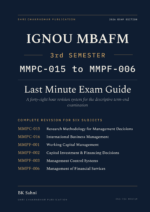




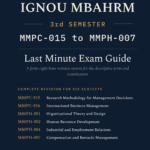
IGNOU MBAFM 3rd Semester Book (MMPC-015 to MMPF-006) — Combined Last Minute Exam Study Guide
Original price was: ₹449.00.₹249.00Current price is: ₹249.00.
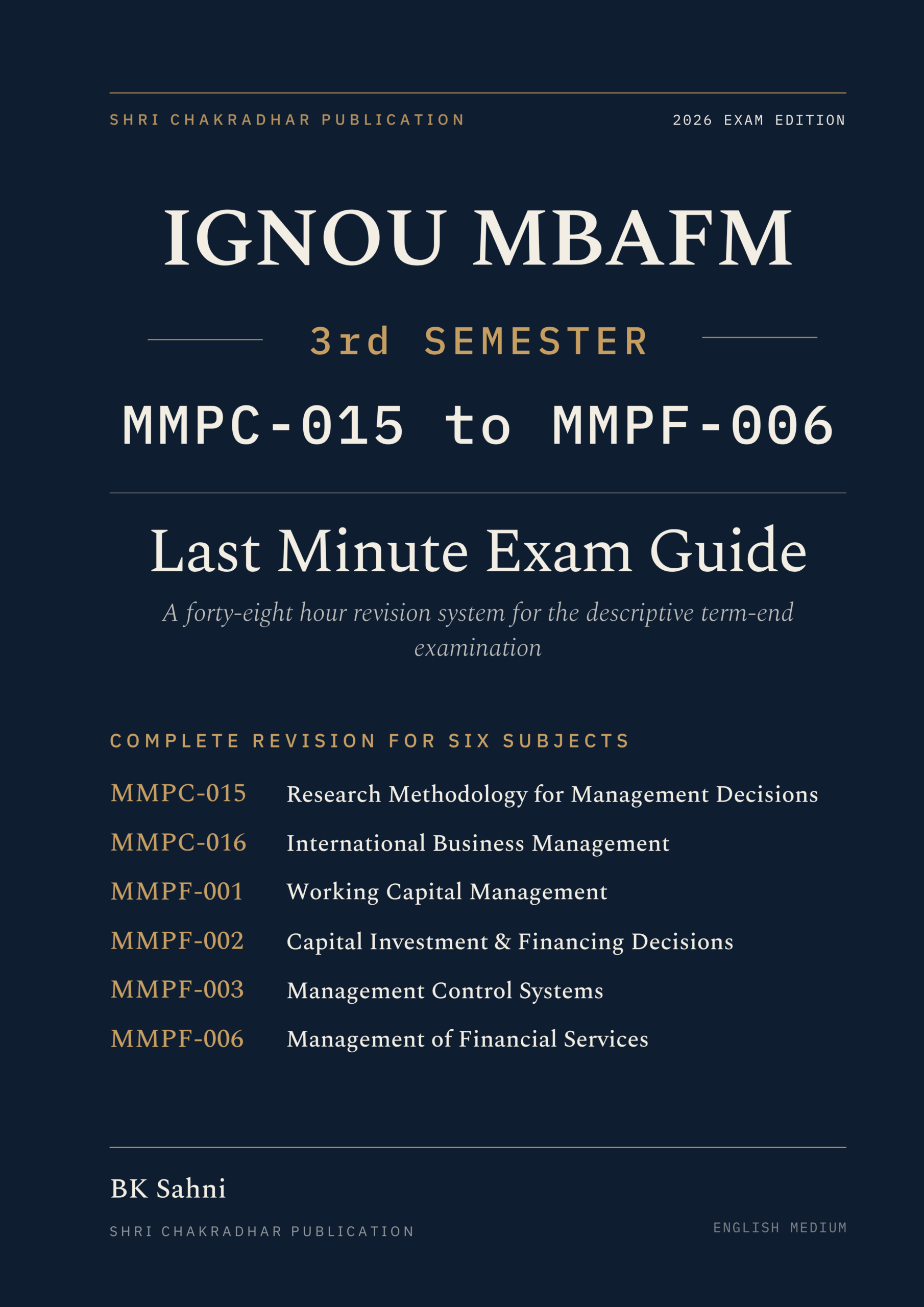
Revise finance as a connected decision system: measure the problem, fund operations, value investments, control performance and understand financial services. This 2026 English Medium IGNOU MBA (FM) Third Semester Last Minute Exam Guide combines MMPC-015, MMPC-016, MMPF-001, MMPF-002, MMPF-003 and MMPF-006 in one 159-page volume.
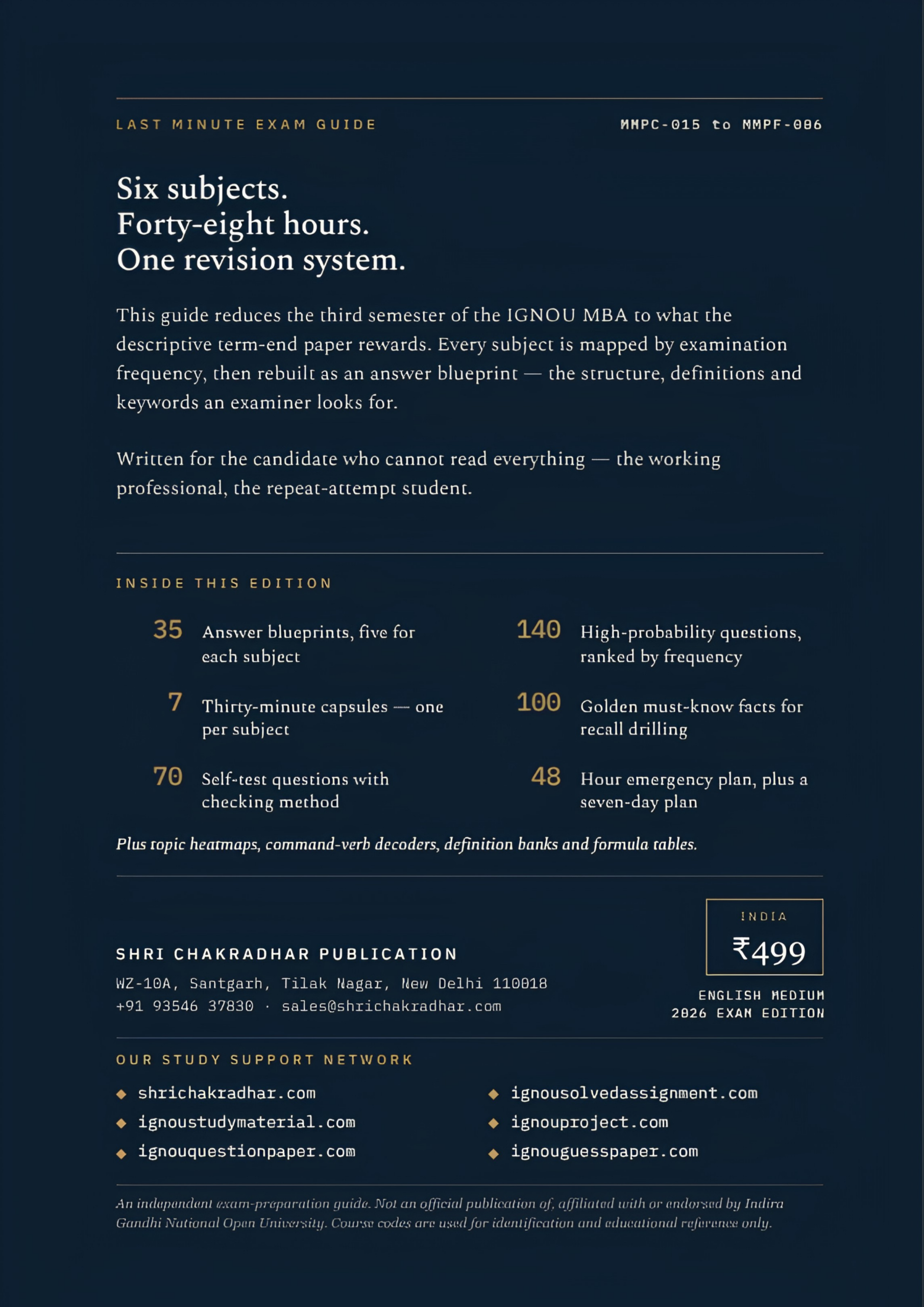
- 120 high-probability Q&As with an individual Exam Note after every numbered answer
- 30 reusable Answer Blueprints for processes, comparisons, critical reviews, frameworks and finance calculations
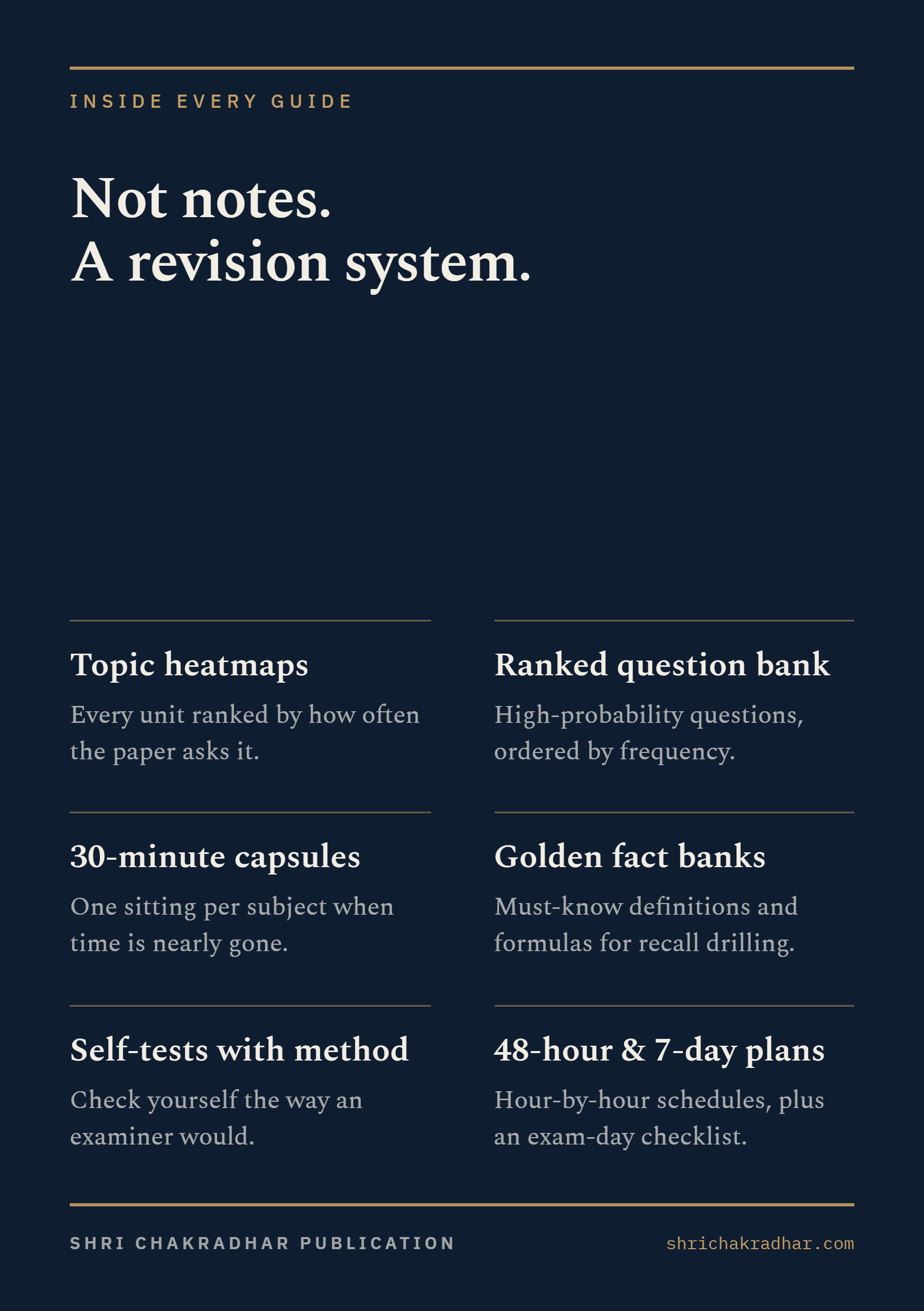
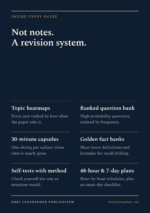
- 6 heatmaps, 6 command decoders and 6 revision toolkits matched to the writing demands of each paper
- 7-day and 48-hour study plans plus six thirty-minute subject capsules for staged revision
- 100 golden facts and 60 self-test questions followed by concise answer guidance
Prepared for Financial Management learners who need formula practice, regulator recall and structured descriptive answers alongside IGNOU’s prescribed material.
Written by BK Sahni — IGNOU education expert and author, guiding distance-learning students since 2010.
IGNOU MBA (FM) Third Semester Book — Formula-Led Revision Across Six Finance Papers
The IGNOU MBA (FM) Third Semester Book is a 159-page English Medium Last Minute Exam Guide for the 2026 Exam Edition. It combines MMPC-015, MMPC-016, MMPF-001, MMPF-002, MMPF-003 and MMPF-006 for revision before the June and December Term-End Examinations. The title is available on IGNOU Study Material, an independent platform for exam-focused IGNOU help books.
The six-paper combination moves from evidence and international context into the operating, investing, control and services sides of finance. Research methodology explains how a managerial claim is tested; international business places capital and risk across borders; working capital focuses on liquidity; capital investment deals with valuation and financing; management control connects numbers with strategy; and financial services maps Indian institutions, markets and regulators. The book therefore changes its answer engine from one chapter to the next instead of forcing every paper into a generic notes format.
About the IGNOU MBA (FM) Third Semester
The Third Semester combination represented in this book contains two common MBA courses and four Financial Management electives. MMPC-015 develops research design, measurement and statistical reasoning, while MMPC-016 studies trade, foreign entry, culture and multinational operations. MMPF-001 then concentrates on short-term funds and liquidity; MMPF-002 addresses long-term investment and financing; MMPF-003 studies how organisations translate strategy into targets, responsibility and performance measurement; and MMPF-006 examines the Indian financial system and its services.
This mix requires rapid switching between descriptive theory, regulatory facts, comparison tables and calculation-led decisions. The guide responds by retaining one six-part navigation system while giving every course its own thinkers, formulas, institutions, examples and writing rules.
What This Book Covers
Every subject chapter follows the same A-to-F route. Students learn where the paper is likely to concentrate, how its command words should be interpreted, which answer structure fits the question, and what must be recalled during the final review.
- Section A — Subject Opener and Topic Heatmap: records the course scope, paper type, key blocks, examination strategy and the book’s priority grading for recurring themes.
- Section B — Command Verb Decoder: distinguishes the response expected for discuss, explain, compare, calculate, critically examine, recommend and other question instructions.
- Section C — Five Answer Blueprints: provides adaptable structures, short answer skeletons and topic-specific keyword banks for each subject.
- Section D — Twenty High-Probability Q&As: supplies numbered model answers of revision length and places an Exam Note after every response.
- Section E — Revision Toolkit: gathers thinkers, formulas or regulators, definition banks, comparison tables and common mistakes.
- Section F — Thirty-Minute Revision Capsule: reduces each paper to five must-remember ideas, selected questions, emergency openings and golden keywords.
The six chapters contain 30 Answer Blueprints, 120 numbered high-probability Q&As, 120 Exam Notes, six heatmaps, six command decoders, six toolkits and six subject capsules. The front and back matter add a seven-day schedule, a 48-hour emergency plan, a semester dashboard, 100 golden facts, an exam-day checklist, 60 self-test questions and concise answer guidance.
Subject-wise Coverage
MMPC-015: Research Methodology for Management Decisions
MMPC-015 establishes the evidence base for the finance specialisation. The chapter covers the eight-stage research process, exploratory, descriptive and causal designs, probability and non-probability sampling, questionnaires, primary and secondary data, Likert and other attitude scales, nominal-to-ratio measurement, reliability, validity, hypotheses, Type I and Type II errors, chi-square and multivariate techniques. Kerlinger, Cooper and Schindler, Fisher, Pearson, Likert and Cronbach supply the attribution framework. Answers are organised as definitions, ordered steps, balanced comparisons or critical evaluations, with formulas and variable meanings included when statistical tools appear.
MMPC-016: International Business Management
MMPC-016 explains the environment in which finance decisions cross national borders. Revision follows Smith, Ricardo, Heckscher-Ohlin, Vernon, Porter, Dunning and Hofstede through comparative advantage, factor endowments, globalisation, WTO agreements, trade blocs, entry modes, alliances, multinational structures, staffing, foreign exchange and logistics. The chapter separates exporting from FDI, tariffs from non-tariff barriers, and global standardisation from adaptation. Its method joins theory, author and year with an Indian or multinational example such as Maruti-Suzuki, Tata-JLR, Infosys or Reliance, then closes with a managerial or policy implication.
MMPF-001: Working Capital Management
MMPF-001 treats liquidity as a sequence of cash tied up and released through operations. It covers gross and net working capital, permanent and temporary requirements, the operating cycle, determinants of working capital, receivables and the 5Cs of credit, Baumol and Miller-Orr cash models, marketable securities, EOQ, ABC, VED, JIT, trade credit, bank credit, commercial paper, factoring, forfaiting and letters of credit. Tandon and Chore Committee recommendations connect the subject to Indian bank finance. Formula-led answers retain operating-cycle components, EOQ, Baumol, Miller-Orr, current and quick ratios, and trade-credit cost.
MMPF-002: Capital Investment & Financing Decisions
MMPF-002 covers how long-term projects are valued, funded and controlled under uncertainty. The chapter revises component costs, WACC, CAPM, the NI, NOI, Traditional and Modigliani-Miller views of capital structure, NPV, IRR, PI, payback, ARR and discounted payback. Risk analysis includes sensitivity, scenarios, Monte Carlo ideas, decision trees and risk-adjusted approaches. Project implementation, PERT and CPM, Social Cost-Benefit Analysis, ADRs, GDRs, ECBs, FCCBs, leases, new issues, mergers, buybacks and derivatives extend the course. Each numerical answer is built from formula, variable definition, substitution, decision rule and interpretation.
MMPF-003: Management Control Systems
MMPF-003 links accounting measures to organisational behaviour and strategic execution. It covers Anthony’s three-level framework, responsibility centres, transfer-pricing methods, fixed, flexible, incremental, zero-based and activity-based budgets, ROI, RI and EVA, the Kaplan-Norton Balanced Scorecard, strategy maps, variance analysis, rewards, TQM, Six Sigma, service organisations, multinationals, projects and non-profit settings. The chapter repeatedly asks students to match authority with controllability and measurement. Formula questions use ROI, RI and EVA; application questions connect cost leadership or differentiation with suitable controls, KPIs and feedback systems.
MMPF-006: Management of Financial Services
MMPF-006 maps the institutions, markets, instruments and services that channel funds in India. Coverage includes RBI, SEBI, IRDAI and PFRDA; mutual-fund structure and NAV; merchant banking; credit-rating agencies; leasing and hire purchase; venture capital; housing finance; depositories and the NSDL-CDSL distinction; factoring, forfaiting, securitisation, PMS, ARCs, insurance, fintech and NBFCs. The answer rule is regulator plus structure plus provider: a service is defined, its participants are organised, its governing body is named, and an Indian institution such as CRISIL, HDFC AMC, SBI Mutual Fund, Bajaj Finance, NSDL or SIDBI illustrates the system.
MMPC-015 to MMPF-006 at a Glance
| Code | Subject Title | Main Revision Area | What You Take Away |
|---|---|---|---|
| MMPC-015 | Research Methodology for Management Decisions | Research design, sampling, measurement, testing and reporting | A defensible sequence from managerial question to interpreted evidence |
| MMPC-016 | International Business Management | Trade theory, WTO, foreign entry, culture and multinational operations | Thinker-led explanations applied to cross-border choices |
| MMPF-001 | Working Capital Management | Operating cycle, cash, inventory, receivables and short-term finance | Formula-supported liquidity and funding decisions |
| MMPF-002 | Capital Investment & Financing Decisions | WACC, valuation, capital structure, risk and long-term sources | Project acceptance and financing logic stated through numbers |
| MMPF-003 | Management Control Systems | Responsibility, budgets, transfer pricing, BSC and performance measures | Control choices aligned with strategy, authority and behaviour |
| MMPF-006 | Management of Financial Services | Regulators, institutions, mutual funds, ratings and financial providers | Regulation-aware descriptions of Indian financial services |
Key Features — All Verified From the Book
- 159-page English Medium edition: one volume combines two core MBA papers and four Financial Management electives.
- 30 Answer Blueprints: every course contains five reusable structures chosen for its theory, calculation or application demands.
- 120 numbered Q&As: twenty selected questions and model answers are provided for each of the six codes.
- 120 Exam Notes: every model response is followed by a focused reminder about marks, structure, variables, examples or omissions.
- 18 chapter-navigation tools: six topic heatmaps, six command-verb decoders and six revision toolkits.
- 6 thirty-minute capsules: one final review section condenses each paper into concepts, questions, starters and keywords.
- 2 staged study schedules: a seven-day route and a 48-hour emergency plan organise the six-subject workload.
- 100 golden facts: concise entries retain theorists, years, formulas, institutions, thresholds and regulator roles.
- 60 self-test questions: ten checks per subject are followed by concise answer guidance for identifying weak areas.
- Finance-specific formula banks: the book collects EOQ, Baumol, Miller-Orr, WACC, CAPM, NPV, PI, ROI, RI, EVA and related decision rules.
Who Should Use This Book
This combined guide is intended for IGNOU MBA (FM) Third Semester learners whose registration matches all six printed codes. It is particularly relevant to working professionals and distance learners who have studied the prescribed blocks but need one organised route through research logic, international theory, liquidity calculations, investment appraisal, performance control and Indian financial regulation.
It also suits students who know a concept yet hesitate over presentation. The blueprints indicate when to number a process, build a comparison table, state a theorist and year, define every symbol in a formula, apply a regulator-service-provider chain or finish with a managerial interpretation.
How This Book Helps Students
The book converts a broad finance semester into repeatable answer decisions. Heatmaps suggest a revision order, while command decoders clarify what the question verb requires. MMPC-015 uses research sequence and evidence; MMPC-016 uses dated theory and international application; MMPF-001 combines operating cycles with short-term finance; MMPF-002 moves from formula to investment verdict; MMPF-003 matches strategy with responsibility and KPIs; and MMPF-006 identifies the regulator, structure and Indian provider behind each service.
The model answers show those patterns in finished form. Exam Notes flag missing formulas, comparisons, examples or statutory references. Toolkits gather the items most easily confused under time pressure, and the six capsules, golden-fact bank and self-test progressively shorten the same material for recall and checking.
This Exam Guide and IGNOU’s Official Study Material
This exam guide supplements the university’s prescribed learning resources; it does not replace them. IGNOU blocks provide complete unit explanations, examples and academic progression for first-time study. Students can download the official IGNOU MBA (FM) study material free in PDF from eGyankosh and should treat those materials as the primary source for all registered courses.
The present volume serves the later revision stage. It reorganises selected content around answer construction, formula recall, comparison, regulatory attribution and timed practice. The probability symbols are study-priority estimates based on past-paper analysis and topic prominence, not confirmed future questions.
Why Choose This Last Minute Exam Guide
The differentiator is its finance-specific answer engineering across six papers. Research answers are built around evidence and validity; international-business answers require theorist-year links; working-capital responses combine cycle logic with liquidity formulas; investment decisions end in accept-or-reject rules; management-control questions connect measures with behaviour; and financial-services answers identify regulator, structure and provider. A single A-to-F route makes navigation predictable without flattening those differences.
The scope is also stated honestly. This is a revision guide for students who have already engaged with the syllabus. Its compressed plans cannot teach six courses from the beginning, and high-probability selections do not limit what IGNOU may examine.
About the Author — BK Sahni
BK Sahni (Bhavya Kumar Sahni) is an IGNOU education expert, author, and the founder of Shri Chakradhar Publication Pvt. Ltd. and ignouproject.com, and he has guided 5,00,000+ IGNOU distance-learning students since 2010. He writes the Last Minute Exam Guide series — including this book — building every title on the method he has refined across a decade of IGNOU-focused work: high-probability questions, reusable answer blueprints, topic heatmaps and quick-revision capsules aligned to the current IGNOU exam pattern. He also publishes open-access research-methodology guides for IGNOU students, archived with permanent DOIs on Zenodo and indexed on Google Scholar and ORCID (0009-0005-8092-459X). Learn more about his work at bksahni.com, or browse his complete catalogue of IGNOU books on the Amazon Author Store.
How to Use the Book Effectively
Begin with the semester dashboard and identify the paper whose method, not merely content, feels least secure. Read its heatmap and verb decoder before studying the five blueprints. Reproduce selected answers by hand. For MMPC-015, write the research sequence and statistical conditions; for MMPC-016, attach author and year to every theory; for MMPF-001, practise operating-cycle, EOQ and cash-model calculations; for MMPF-002, define each WACC, CAPM, NPV or PI variable; for MMPF-003, connect KPIs with responsibility and strategy; and for MMPF-006, name the regulator and service structure.
Choose the seven-day plan when time allows or the 48-hour route only after earlier study. Extend answer practice with IGNOU previous years solved question papers, and use free IGNOU study support and resources on IGNOU Project for supplementary guidance. Complete all 60 self-test items, revise the errors from Section E, and reserve the relevant Section F capsule for the final thirty minutes before each paper.
Frequently Asked Questions
Which subjects and course codes are included in this IGNOU MBA (FM) Third Semester Book?
The book covers six courses: MMPC-015 Research Methodology for Management Decisions, MMPC-016 International Business Management, MMPF-001 Working Capital Management, MMPF-002 Capital Investment & Financing Decisions, MMPF-003 Management Control Systems and MMPF-006 Management of Financial Services. Each paper has its own six-section chapter.
Is this product one combined book or six separately bound finance helpbooks?
It is one combined 159-page English Medium volume. The six papers remain separated by code, subject title and chapter, but they share one navigation system from heatmap to capsule. You receive a single Third Semester revision guide rather than six individual books.
Is the 2026 edition useful for the June and December Term-End Examinations?
Yes. The book is structured for revision before the June and December Term-End Examinations and supports descriptive, comparative, numerical, regulatory and application-based questions. Its priority labels help organise study time, but they do not confirm the content of any future question paper.
Does the book contain solved assignments, complete previous-year papers or a separate guess paper?
No. Solved assignments, full previous-year question papers, handwritten submissions and a standalone guess paper are not included. The book instead provides 120 selected model Q&As, 30 Answer Blueprints, six toolkits, formula banks, 100 golden facts and a 60-question self-test for exam revision.
Can this Last Minute Exam Guide replace the prescribed IGNOU MBA material?
No. The guide cannot replace IGNOU’s prescribed blocks because it condenses selected concepts into answer structures and recall tools. Use the university material for complete unit understanding, then use this book for writing practice, formula rehearsal, comparison, regulatory recall and final-stage consolidation.
Who should consider buying this Financial Management study guide?
The intended buyer is an IGNOU MBA (FM) Third Semester student registered for the six listed codes. It is especially suitable for working professionals, distance learners and students who need one structured source for research, international business, working capital, investment, control systems and financial services.
How should I choose between the seven-day plan and the 48-hour emergency plan?
Use the seven-day schedule when you can study every chapter in sequence and practise answers over several sessions. The 48-hour route assumes the prescribed material has already been read and concentrates on blueprints, selected Q&As, formulas, toolkits and capsules. It is a revision plan, not a first-reading plan.
Are all 120 high-probability questions expected to appear in the examination?
No. The book states that its probability ratings are estimates based on earlier examinations and topic prominence. They can help prioritise limited time, but IGNOU may ask any question from the applicable syllabus. Students should treat the Q&As as structured practice rather than a prediction.
Should I verify the current MBA (FM) course combination before ordering?
Yes. Check www.ignou.ac.in for the latest programme structure, registered codes, study material, date sheet and examination instructions. This edition follows the MMPC-015 to MMPF-006 combination shown on its cover, so verification avoids a mismatch after a programme revision or elective change.
Important Note on Syllabus Verification
IGNOU periodically updates its programme structure, assignment requirements, examination schedule and study material. Before purchasing and while preparing, students should verify the latest MBA (FM) syllabus, course list, date sheet and official instructions on the official IGNOU website (www.ignou.ac.in). This book is aligned to the MMPC-015, MMPC-016, MMPF-001, MMPF-002, MMPF-003 and MMPF-006 structure and refreshed as an annual exam edition, but official IGNOU sources are always the final authority.
Non-Affiliation Disclaimer
ignoustudymaterial.com is an independent educational publishing platform. This book and this website are not officially affiliated with, endorsed by, or operated by the Indira Gandhi National Open University (IGNOU). Course codes such as MMPC-015, MMPC-016, MMPF-001, MMPF-002, MMPF-003 and MMPF-006 are used solely to identify the subjects the book covers. IGNOU’s official study material and notifications remain the primary and authoritative sources for the programme.
Get Your Copy
Select this combined finance revision book when you need one organised path across research, global business, liquidity, investment, control and financial services. Keep the prescribed blocks as the learning base, practise formulas and answer frameworks, and use the capsules for immediate recall. For digital access, get the IGNOU MBA (FM) Third Semester Book (MMPC-015 to MMPF-006) — Combined Last Minute Exam Study Guide as a soft-copy PDF on WhatsApp.
| Weight | 250 g |
|---|---|
| Dimensions | 22 × 16 × 1 cm |


Reviews
There are no reviews yet.