
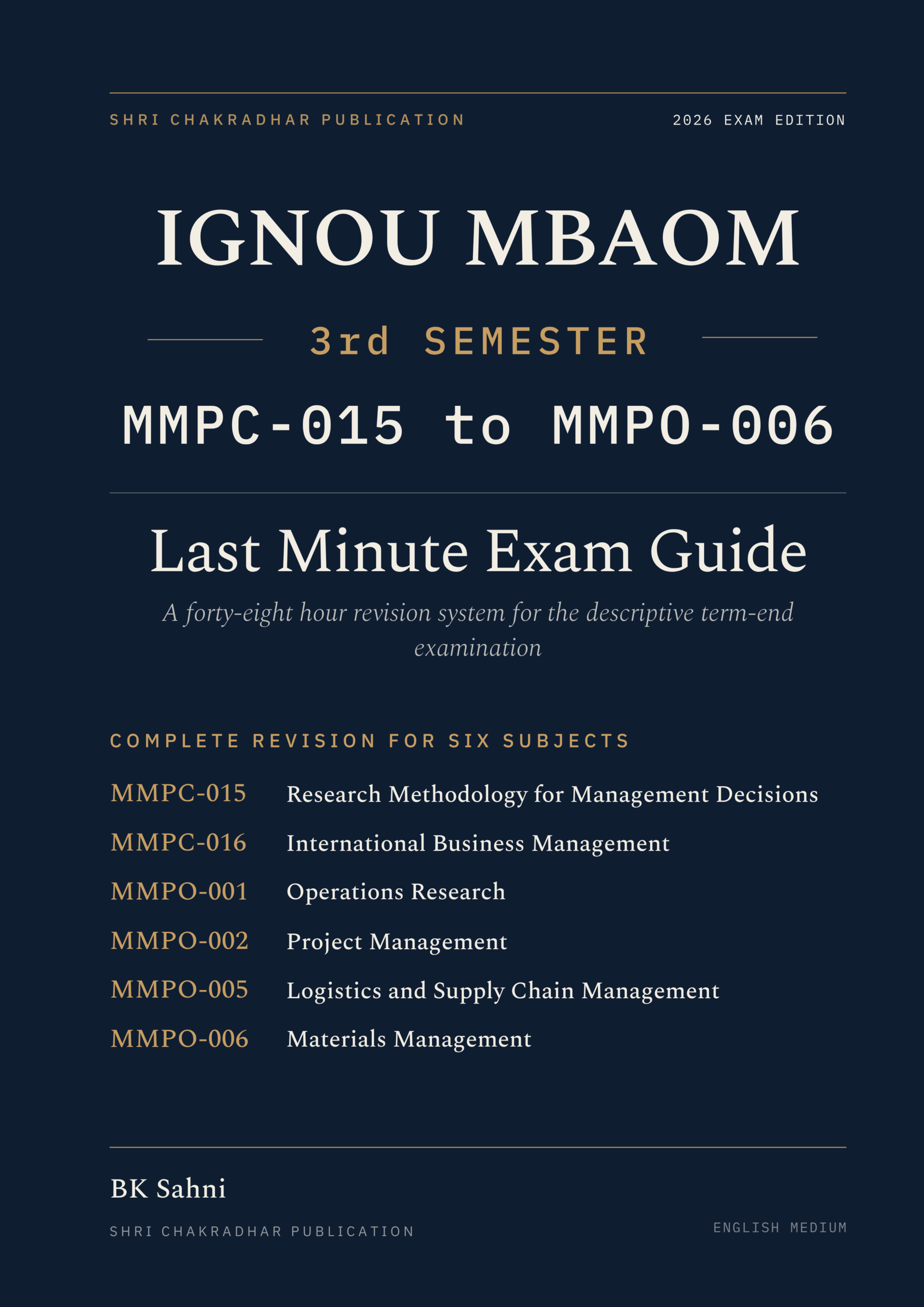

IGNOU MBA (OM) 3rd Semester Book (MMPC-015 to MMPO-006) — Combined Last Minute Exam Study Guide
Original price was: ₹499.00.₹249.00Current price is: ₹249.00.
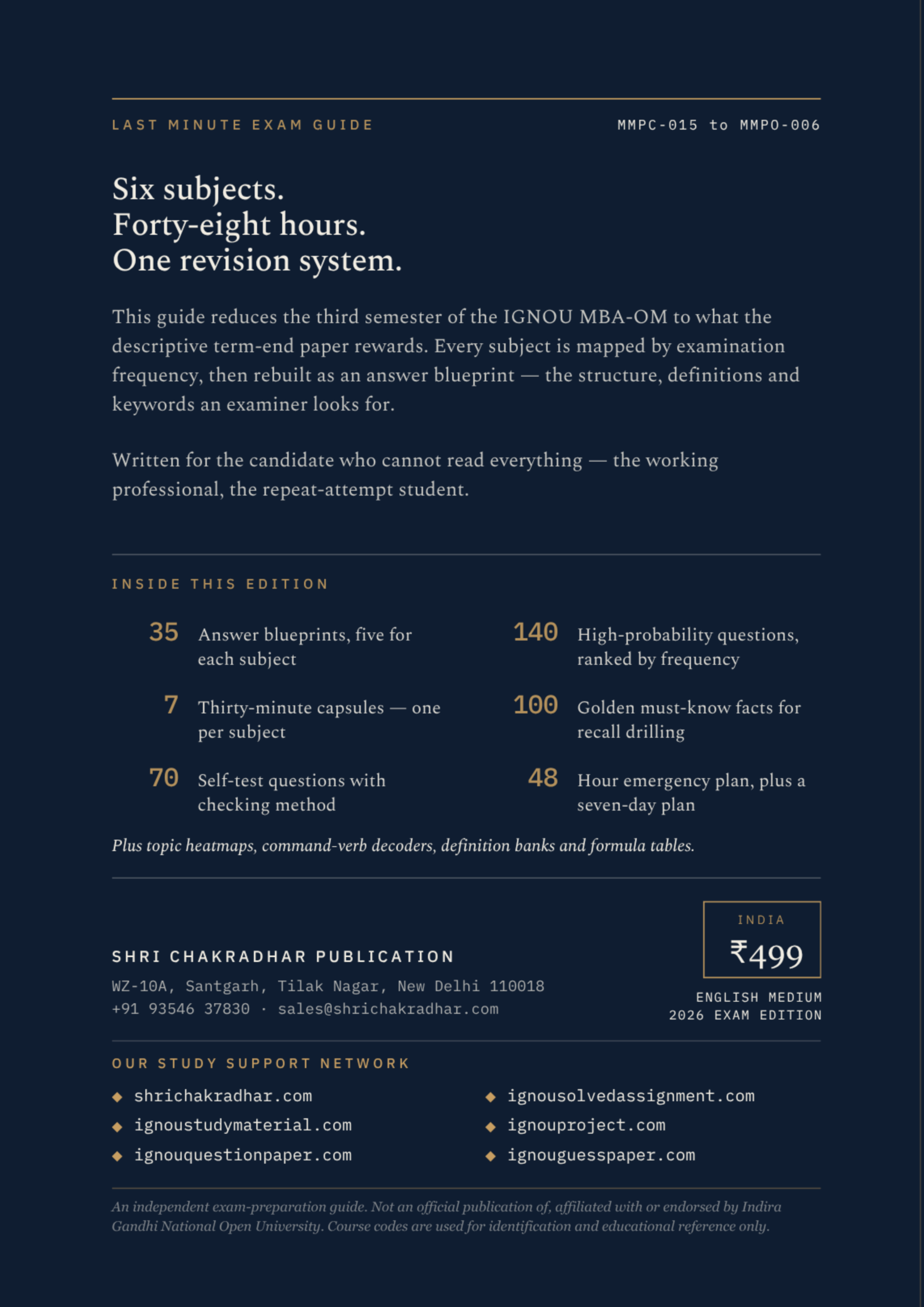
Connect research, quantitative modelling, project control, supply chains and materials decisions through one operations-focused revision route. This 2027 English Medium IGNOU MBA (OM) 3rd Semester Last Minute Exam Guide combines MMPC-015, MMPC-016, MMPO-001, MMPO-002, MMPO-005 and MMPO-006 in one 156-page volume.
- 120 numbered model Q&As with a separate Exam Note after every answer
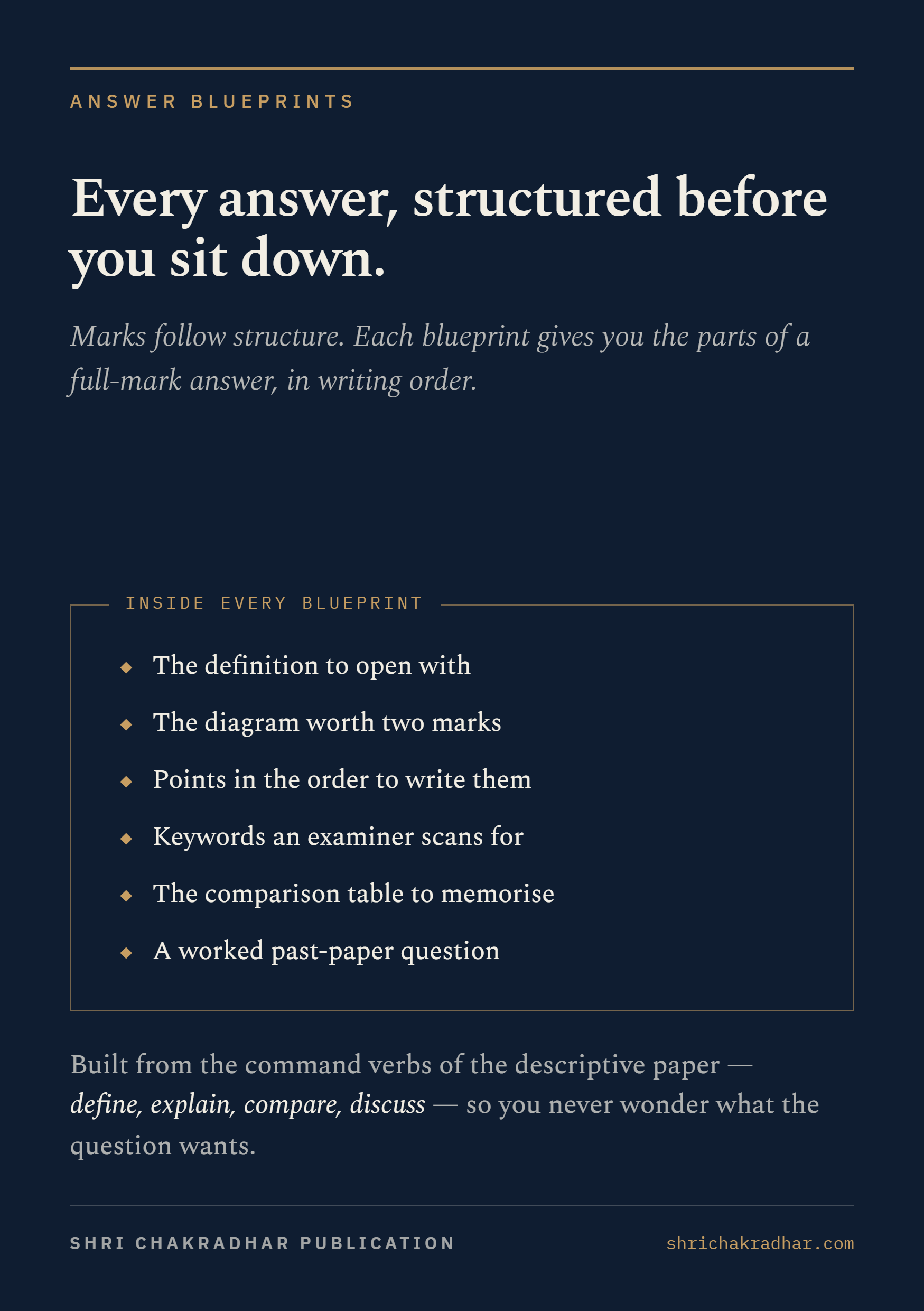
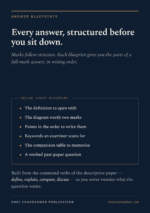
- 30 reusable Answer Blueprints for research, algorithms, networks, comparisons and control processes
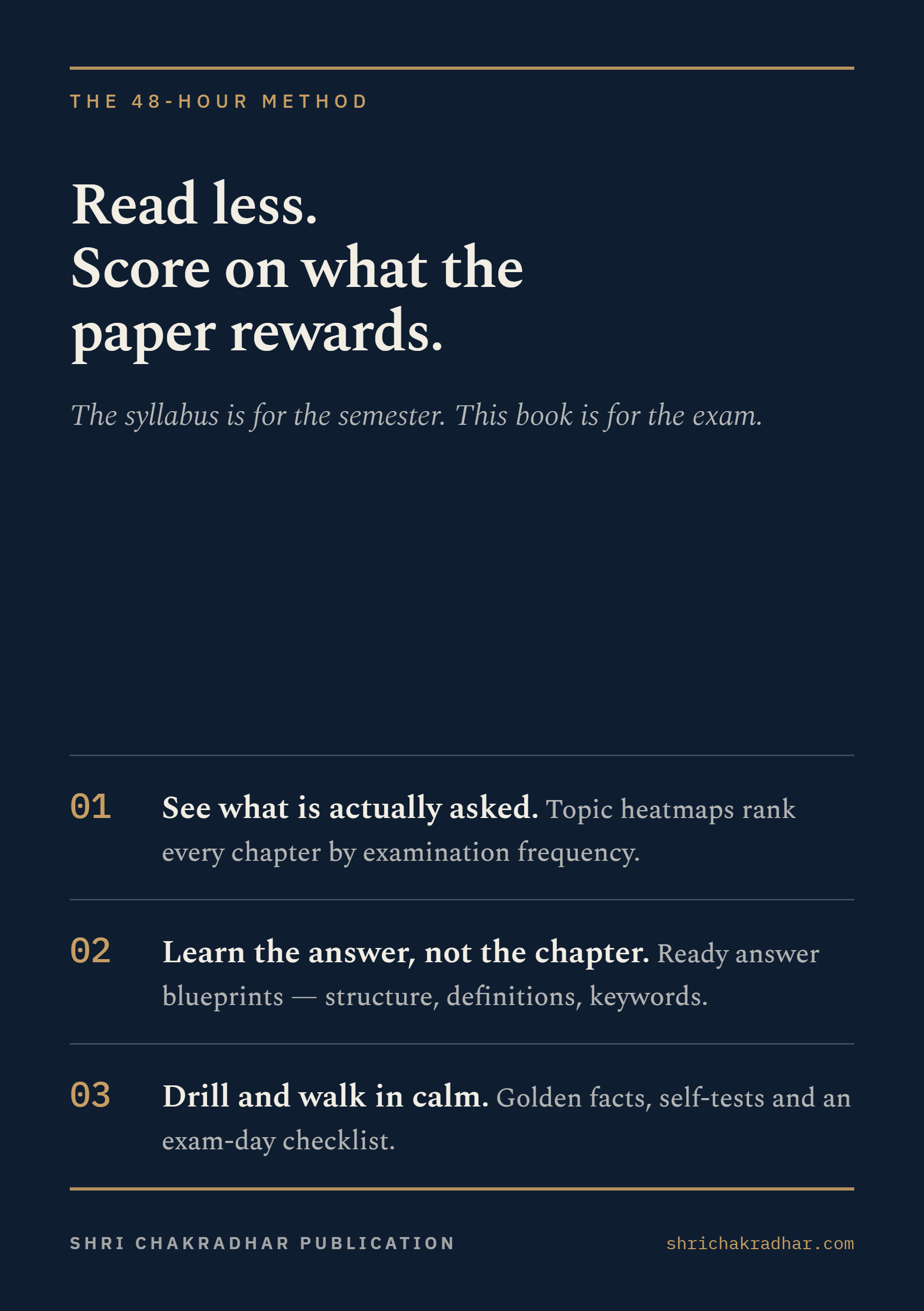
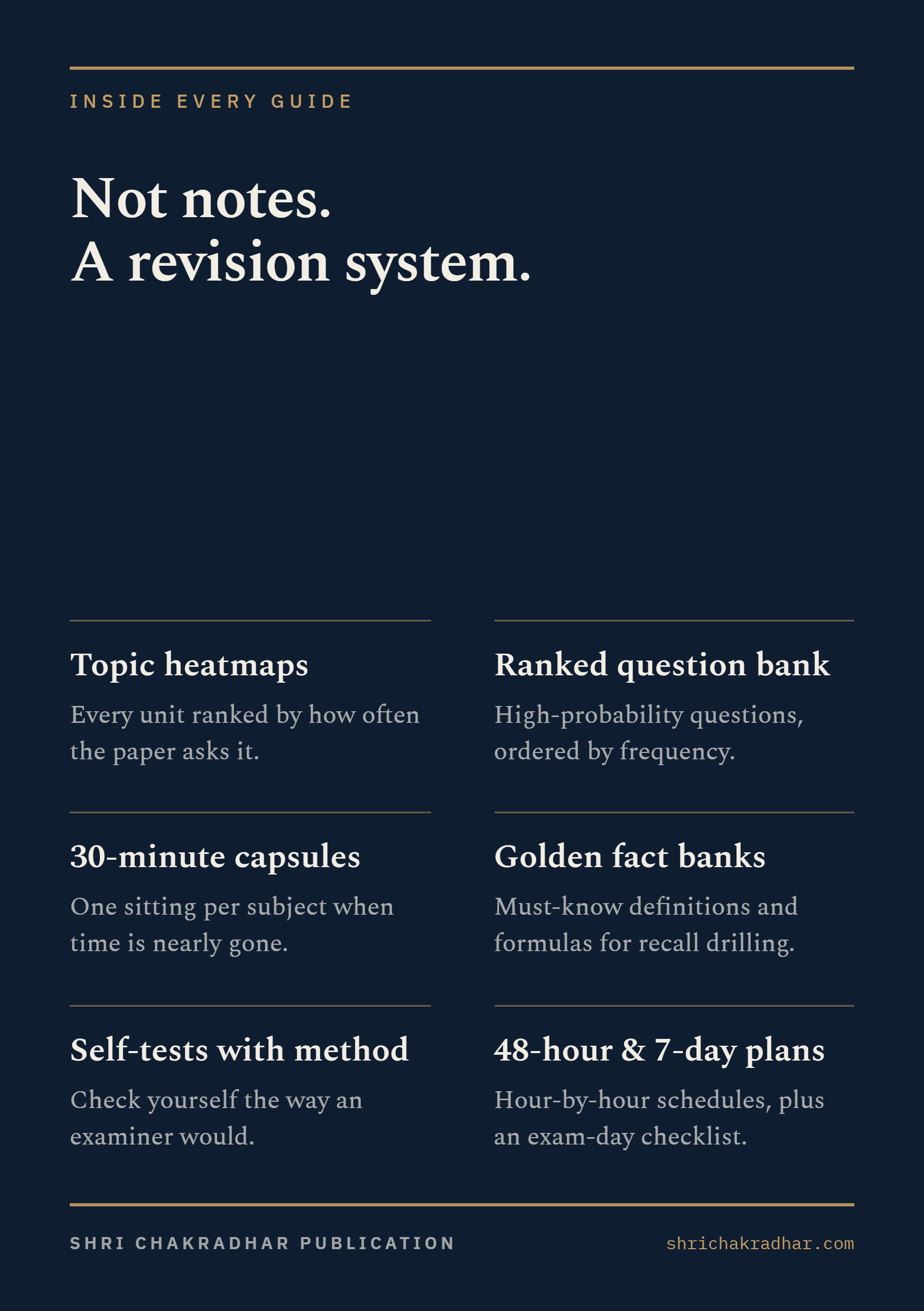
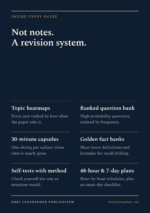
- 18 subject-level navigation aids through six heatmaps, six command decoders and six revision toolkits
- Six thirty-minute capsules and six time-window routes ranging from 48 hours to 1 hour
- 160 recall checks through 100 golden facts and a 60-question self-test with answers
Prepared for Operations Management distance learners revising formulas, project frameworks, logistics trade-offs and inventory-control rules after studying the prescribed IGNOU material.
Written by BK Sahni — IGNOU education expert and author, guiding distance-learning students since 2010.
IGNOU MBA (OM) 3rd Semester Book — From Mathematical Models to End-to-End Operations Control
The IGNOU MBA (OM) 3rd Semester Book is a 156-page English Medium Last Minute Exam Guide for the 2027 Exam Edition. It brings MMPC-015, MMPC-016, MMPO-001, MMPO-002, MMPO-005 and MMPO-006 into one revision companion for the June and December Term-End Examinations. The title is available on IGNOU Study Material, an independent platform for exam-focused IGNOU help books.
The course sequence links evidence, global context and the operational flow of work. Research methodology establishes how management questions are investigated; international business explains the cross-border environment; Operations Research turns constraints into mathematical models; Project Management plans temporary undertakings; Logistics and Supply Chain Management follows products, information and service across networks; and Materials Management governs sourcing, inventory, codification and supplier performance. The guide preserves those differences by changing the answer method from statistical testing to algorithm tables, network calculations, process maps, cost-service trade-offs and selective-control rules.
About the IGNOU MBA (OM) 3rd Semester
The IGNOU MBA (OM) 3rd Semester represented in this book contains two common management courses and four Operations Management specialisation papers. MMPC-015 and MMPC-016 provide research and international-business foundations. MMPO-001 then develops quantitative decision models, MMPO-002 organises projects through scope, schedules, risk and control, MMPO-005 examines logistics and integrated supply chains, and MMPO-006 focuses on the planning, purchase, storage and control of materials.
This combination requires several examination languages. A learner may need to state hypotheses and significance levels, build a linear programme, show simplex or transportation logic, calculate PERT duration and earned-value indices, explain the bullwhip effect, or classify inventory through ABC, VED, FSN, SDE and HML. The book uses one recognisable chapter route while retaining the formulas, frameworks and control principles specific to each paper.
What This Book Covers
Every course chapter follows a six-stage revision design that moves from orientation to retrieval. The repeated map reduces search time, but each stage is populated with the terminology and problem-solving method of the relevant subject.
- Section A — Subject Opener and Topic Heatmap: identifies the paper structure, key blocks, examination strategy and the book’s priority grading for recurring topics.
- Section B — Command Verb Decoder: translates instructions such as formulate, solve, compare, evaluate, calculate, discuss and illustrate into the answer form expected.
- Section C — Five Answer Blueprints: supplies adaptable frameworks, compact answer skeletons and a subject-specific keyword bank.
- Section D — Twenty High-Probability Q&As: demonstrates numbered model responses, with one focused Exam Note placed after every answer.
- Section E — Revision Toolkit: consolidates thinkers, formulas, definitions, comparison tables and common mistakes for the paper.
- Section F — Thirty-Minute Revision Capsule: reduces the subject to must-remember concepts, selected questions, emergency answer openings and golden terminology.
Across six subjects, the book contains 30 Answer Blueprints, 120 numbered high-probability Q&As, 120 Exam Notes, six topic heatmaps, six command decoders, six revision toolkits and six thirty-minute capsules. Four additional case-based exercises appear in MMPC-015 and MMPC-016. Semester-wide support includes a dashboard, six reading routes for 48, 24, 12, 6, 3 and 1 hour, a two-day emergency plan, 100 golden facts, an exam-day checklist, 60 multiple-choice self-test questions, an answer key and score interpretation.
Subject-wise Coverage
MMPC-015: Research Methodology for Management Decisions
MMPC-015 develops the evidence discipline behind operational decisions. The chapter covers research types and process, problem formulation, exploratory, descriptive and causal designs, probability and non-probability sampling, questionnaires, data sources, measurement scales, reliability, validity, hypotheses, Type I and Type II errors, data processing, chi-square, t-tests, ANOVA, correlation, regression, reporting and ethics. Kerlinger, Kothari, Fisher, Pearson, Likert and Cronbach anchor the theory. Numerical responses follow hypotheses, formula, variables, computation, critical-value comparison and managerial interpretation, while two applied cases practise chi-square and small-sample testing.
MMPC-016: International Business Management
MMPC-016 places operations inside international markets, institutions and cultures. Its material moves from Smith, Ricardo and Heckscher-Ohlin through Vernon, Krugman, Porter, Hymer, Dunning’s OLI paradigm and the Uppsala model. Students revise globalisation, FDI, entry modes, licensing, franchising, alliances, WTO agreements, regional integration, international marketing, organisational structures, foreign exchange, Balance of Payments, Hofstede, expatriate management, logistics and cross-border risk. Tata-JLR, Hindalco-Novelis, Maruti-Suzuki and Infosys illustrate application. Two cases ask students to select an entry route and balance standardisation with adaptation.
MMPO-001: Operations Research
MMPO-001 is the quantitative core of the specialisation. It covers the origin and scope of Operations Research, model classification, linear-programming formulation, graphical solution, simplex, duality, sensitivity, integer programming, transportation through NWC, VAM and MODI, assignment through the Hungarian method, M/M/1 queues, CPM, PERT, floats, crashing, EOQ, EMV, EOL, EVPI, game theory, Monte Carlo simulation and replacement analysis. Dantzig, Kuhn, Erlang, Kendall, Little, von Neumann and Harris-Wilson appear in the thinker bank. The chapter repeatedly requires standard form, visible iterations, defined variables, stopping tests and a final business interpretation.
MMPO-002: Project Management
MMPO-002 treats a project as a temporary, unique and progressively elaborated undertaking. Revision covers PMBOK knowledge areas and process groups, feasibility, life-cycle phases, environment, stakeholders, charter, scope statement, WBS, work packages, responsibility matrices, Gantt charts, CPM, PERT, float types, risk registers, the triple constraint, monitoring, earned value, Waterfall, Agile, project structures, Tuckman’s team stages, resource allocation, levelling, smoothing, closure and audit. Formula work includes expected duration, variance, PV, EV, AC, SV, CV, SPI and CPI. Indian project references include Delhi Metro, Chandrayaan and the Dedicated Freight Corridor.
MMPO-005: Logistics and Supply Chain Management
MMPO-005 follows physical flow, information and working capital across the chain. It covers the CSCMP logistics definition, seven Rs, manufacturing and marketing interfaces, customer service, total-cost trade-offs, balance-sheet effects, transport and carrier selection, rail-road comparison, warehousing, cross-docking, the bullwhip effect, supply-chain integration, efficient and responsive strategies, product-versus-service chains, information technology, e-SCM, SCOR measurement, benchmarking, supplier relationships, 3PL, 4PL, ECR and VMI. Forrester, Lee-Padmanabhan-Whang, Fisher and the SCOR framework organise the subject. Examples include Amul’s cold chain, Maruti’s vendor park and fulfilment networks.
MMPO-006: Materials Management
MMPO-006 connects purchasing, supplier capability and stores control to operational continuity. The chapter covers materials-management functions, integration with production and finance, supplier-network design, vendor evaluation and development, buyer-seller relationships, materials planning, bills of material, MRP, budgets, ABC, VED, FSN, SDE, HML and XYZ analysis, EOQ, reorder level, safety stock, push and pull, JIT, kanban, WIP, spare-parts control, codification, standardisation, variety reduction, sourcing choice, warehouse design, risk, SCOR, value analysis and make-or-buy. Its answer rule pairs every classification with a control action, a number and an Indian materials example.
MMPC-015 to MMPO-006 at a Glance
| Code | Subject Title | Main Revision Area | What You Take Away |
|---|---|---|---|
| MMPC-015 | Research Methodology for Management Decisions | Design, sampling, measurement, testing and reporting | A defensible route from management question to interpreted evidence |
| MMPC-016 | International Business Management | Trade theory, foreign entry, WTO, culture and global operations | Cross-border choices supported by attributed theory and examples |
| MMPO-001 | Operations Research | Optimisation, allocation, queues, networks, inventory and decisions | Models solved transparently and translated into managerial action |
| MMPO-002 | Project Management | Feasibility, scope, schedules, risk, earned value and closure | Temporary work planned and controlled through named frameworks |
| MMPO-005 | Logistics and Supply Chain Management | Flow, service, transport, integration, bullwhip and SCOR | Chain decisions evaluated through cost, responsiveness and trade-offs |
| MMPO-006 | Materials Management | Sourcing, planning, inventory classes, stores and supplier performance | Selective control rules tied to value, criticality and availability |
Key Features — All Verified From the Book
- 156-page English Medium edition: two common MBA papers and four Operations Management courses are contained in one volume.
- 30 Answer Blueprints: every course contributes five reusable structures matched to its theory, process, comparison or numerical demands.
- 120 numbered model Q&As: twenty high-probability questions and revision answers are included for each code.
- 120 individual Exam Notes: every numbered answer ends with a targeted reminder about structure, formulas, examples or omitted conditions.
- 4 case-based practice exercises: MMPC-015 and MMPC-016 provide two applied situations each.
- 18 subject navigation tools: six heatmaps, six command-verb decoders and six toolkits support prioritisation and checking.
- 6 thirty-minute capsules: every subject closes with essential concepts, selected questions, emergency starters and golden keywords.
- 6 time-window reading routes: the book specifies approaches for 48, 24, 12, 6, 3 and 1 hour of available revision time.
- 100 golden facts: the back matter gathers formulas, authors, years, control rules and framework sequences across the semester.
- 60 self-test questions: ten multiple-choice checks per subject are followed by an answer key and score bands.
Who Should Use This Book
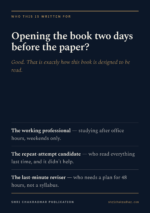
This combined guide is intended for IGNOU MBA (OM) 3rd Semester learners whose registration matches the six printed course codes. It is particularly relevant after the prescribed blocks have been studied and the remaining problem is coordination: one paper demands statistical reasoning, another asks for dated international theories, and the four MMPO papers require algorithms, networks, process documents, chain trade-offs and materials classifications.
Working professionals and independent distance learners may use the repeated six-section layout to move between subjects without rebuilding their study method. The title also suits students who understand a concept but lose clarity while writing calculations, comparison tables, project frameworks or control recommendations under examination time limits.
How This Book Helps Students
The book converts a technically varied semester into observable answer decisions. Heatmaps suggest where to allocate revision time, and verb decoders distinguish a request to formulate from one to evaluate or compare. The blueprints then assign a form: MMPC-015 uses research sequence and tests; MMPC-016 links theory, year and corporate application; MMPO-001 requires standard models and complete workings; MMPO-002 uses documents, networks and control indices; MMPO-005 follows cause, consequence, remedy and trade-off; MMPO-006 joins classification with its operating rule.
Model answers show those methods in finished form. Exam Notes flag missing assumptions, variables, optimality checks, examples or conclusions. The toolkits gather formulas and definitions that are easily confused, while the capsules, golden-fact bank and self-test create progressively shorter recall and diagnosis stages.
This Exam Guide and IGNOU’s Official Study Material
This Last Minute Exam Guide is a supplement to the prescribed university material, not a substitute for it. IGNOU blocks provide the complete unit development, examples and academic context required for initial learning. Students can download the official IGNOU MBA (OM) study material free in PDF from eGyankosh and should treat those resources as the primary reference for all six registered courses.
The present book serves the later revision stage. It reorganises selected topics around answer construction, numerical procedure, framework recall and timed practice. Its probability symbols express study priorities derived from earlier papers and topic prominence; they do not define the full syllabus or disclose a future examination.
Why Choose This Last Minute Exam Guide
The useful distinction is the subject-specific operating logic inside one consistent format. Research answers move from design to evidence, international-business answers connect propositions with dates and cases, Operations Research exposes every computational step, Project Management names the document or index produced, logistics answers close on cost-service consequences, and materials answers state the control rule attached to each class. That design makes one volume coherent without turning six courses into generic notes.
The boundaries are equally explicit. This is a revision companion for learners who have already engaged with the syllabus. It does not contain solved assignments, complete previous-year papers, handwritten submissions or a standalone guess paper, and the short reading routes cannot replace foundational study.
About the Author — BK Sahni
BK Sahni (Bhavya Kumar Sahni) is an IGNOU education expert, author, and the founder of Shri Chakradhar Publication Pvt. Ltd. and ignouproject.com, and he has guided 5,00,000+ IGNOU distance-learning students since 2010. He writes the Last Minute Exam Guide series — including this book — building every title on the method he has refined across a decade of IGNOU-focused work: high-probability questions, reusable answer blueprints, topic heatmaps and quick-revision capsules aligned to the current IGNOU exam pattern. He also publishes open-access research-methodology guides for IGNOU students, archived with permanent DOIs on Zenodo and indexed on Google Scholar and ORCID (0009-0005-8092-459X). Learn more about his work at bksahni.com, or browse his complete catalogue of IGNOU books on the Amazon Author Store.
How to Use the Book Effectively
Start with the semester dashboard and identify whether the weakest point is recall, structure or calculation. Read the heatmap and command decoder before learning the five blueprints. Reproduce selected answers without looking. In MMPC-015, write hypotheses and testing decisions; in MMPC-016, attach authors and years to theories; in MMPO-001, show standard form, iterations and optimality; in MMPO-002, practise networks and earned-value indices; in MMPO-005, map trade-offs and remedies; and in MMPO-006, pair every inventory class with its control policy.
Choose the longest reading route that fits work already completed. Extend timed practice with IGNOU previous years solved question papers, and consult free IGNOU study support and resources on IGNOU Project for supplementary guidance. Attempt all 60 self-test questions, reopen the toolkit for each error, and reserve the relevant thirty-minute capsule for immediate pre-paper recall.
Frequently Asked Questions
Which subjects are included in this IGNOU MBA (OM) 3rd Semester Book?
The book covers MMPC-015 Research Methodology for Management Decisions, MMPC-016 International Business Management, MMPO-001 Operations Research, MMPO-002 Project Management, MMPO-005 Logistics and Supply Chain Management, and MMPO-006 Materials Management. Each code has a separate six-section chapter with its own heatmap, blueprints, model answers, toolkit and capsule.
Is this product one combined volume or six individual course books?
It is one combined 156-page English Medium book. The six subjects remain clearly separated by code and chapter, but they share a common revision route from topic mapping to final capsule. The order therefore supplies one bound 2027 Exam Edition rather than a set of six separately printed helpbooks.
Can the guide be used for both June and December Term-End Examinations?
Yes. Its answer frameworks, calculations, comparisons, process maps and recall tools can support revision before either June or December Term-End Examination session. The high-probability labels help sequence limited study time, but they are not confirmations of the questions that will appear in a particular paper.
Does it provide solved assignments, full PYQ papers or a separate guess paper?
No. Solved assignments, complete previous-year question papers, handwritten submissions and a standalone guess paper are not included. The book instead provides 120 numbered model Q&As, 30 Answer Blueprints, four applied cases, six toolkits, 100 golden facts and a 60-question self-test for examination revision.
Can this operations study guide replace the prescribed IGNOU blocks?
No. The guide cannot replace the prescribed blocks because it condenses selected material into revision structures and problem-solving routines. Use IGNOU’s study material for complete concepts and unit context, then use this book for algorithm rehearsal, formula recall, framework application, answer organisation and final-stage consolidation.
Who is the intended reader for this 3rd Semester Operations Management edition?
The intended reader is an IGNOU MBA (OM) learner registered for the six listed codes and already familiar with the course material. It is especially suitable for employed students and self-directed distance learners who need one workflow across research, international business, optimisation, projects, logistics and materials control.
How should I choose among the 48-hour to 1-hour reading plans?
Select the route according to prior preparation, not merely the clock. The 48-hour version includes broad chapter work, answer writing and testing; shorter plans progressively concentrate on selected questions, blueprints, capsules and golden facts. The 1-hour route is a rapid recall sweep and cannot teach six courses from the beginning.
Are the 120 selected questions predictions of the next examination?
No. They are study-priority questions based on patterns in earlier examinations and the prominence of topics in the learning material. They help organise revision but do not determine the next paper. IGNOU may assess any applicable syllabus area, so the model answers should be treated as structured practice rather than a forecast.
Should the latest MBA (OM) structure be checked before ordering?
Yes. Verify your registered courses, the current programme structure, date sheet, study material and examination instructions at www.ignou.ac.in. This edition follows the MMPC-015, MMPC-016, MMPO-001, MMPO-002, MMPO-005 and MMPO-006 combination printed in the book, and another cycle or specialisation may differ.
Important Note on Syllabus Verification
IGNOU periodically updates its programme structure, assignment requirements, examination schedule and study material. Before purchasing and while preparing, students should verify the latest MBA (OM) syllabus, course list, date sheet and official instructions on the official IGNOU website (www.ignou.ac.in). This book is aligned to the MMPC-015, MMPC-016, MMPO-001, MMPO-002, MMPO-005 and MMPO-006 structure and refreshed as an annual exam edition, but official IGNOU sources are always the final authority.
Non-Affiliation Disclaimer
ignoustudymaterial.com is an independent educational publishing platform. This book and this website are not officially affiliated with, endorsed by, or operated by the Indira Gandhi National Open University (IGNOU). Course codes such as MMPC-015, MMPC-016, MMPO-001, MMPO-002, MMPO-005 and MMPO-006 are used solely to identify the subjects the book covers. IGNOU’s official study material and notifications remain the primary and authoritative sources for the programme.
Get Your Copy
Select this combined operations revision guide when one organised source is more practical than scattered notes for six papers. Keep the official blocks as the learning base, write the model structures and calculations independently, and use the capsules only for final retrieval. For digital access, get the IGNOU MBA (OM) 3rd Semester Book (MMPC-015 to MMPO-006) — Combined Last Minute Exam Study Guide as a soft-copy PDF on WhatsApp.
| Weight | 250 g |
|---|---|
| Dimensions | 22 × 16 × 1 cm |



Reviews
There are no reviews yet.