
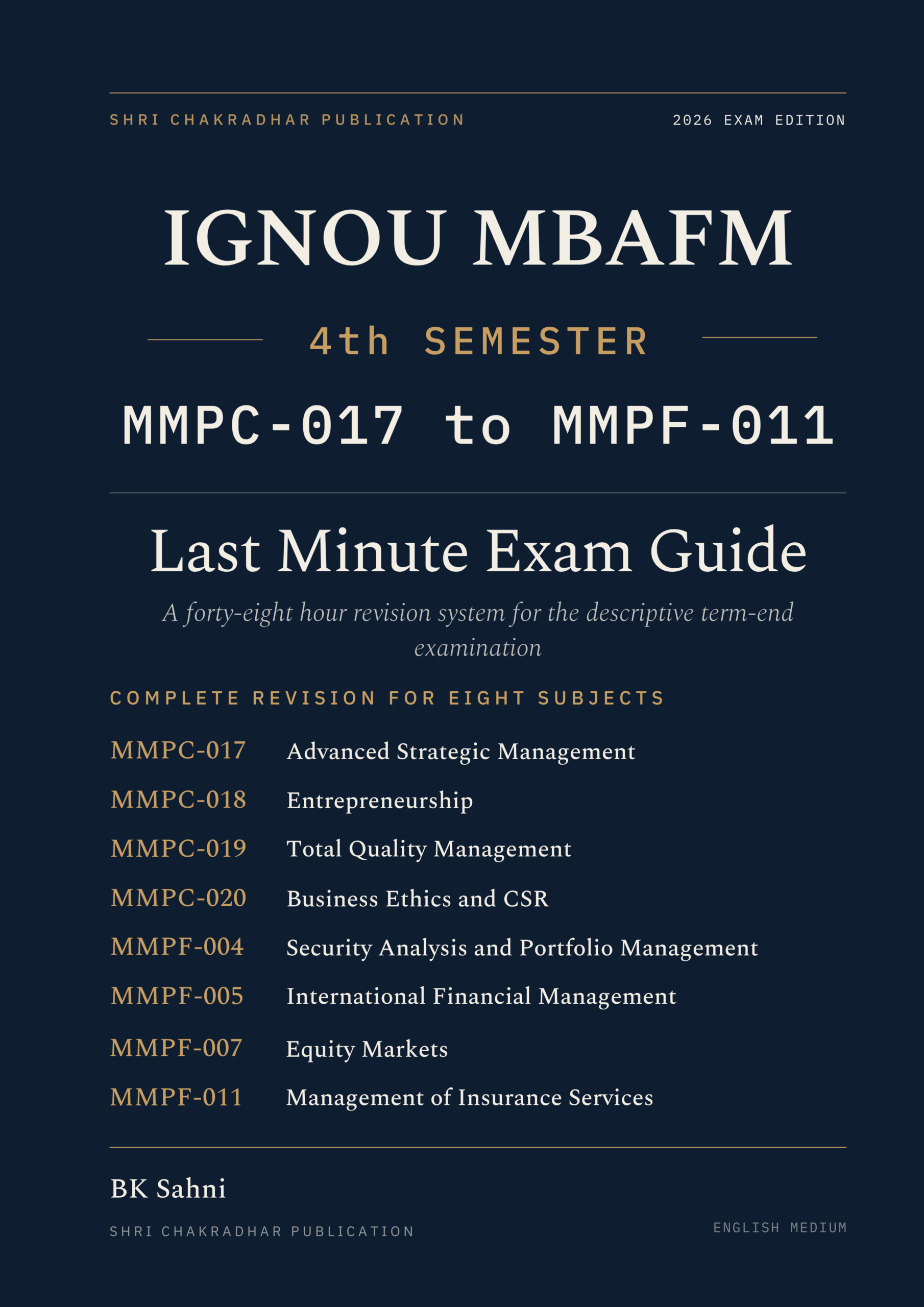



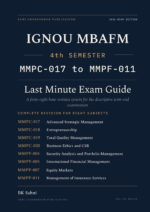




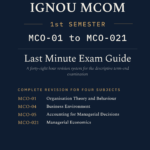
IGNOU MBA (FM) 4th Semester Book (MMPC-017 to MMPF-011) — Combined Last Minute Exam Study Guide
Original price was: ₹499.00.₹249.00Current price is: ₹249.00.
Move from strategic choices and venture creation to portfolio models, foreign exchange, equity-market regulation and insurance through one 4th Semester revision route. This 2027 English Medium IGNOU MBA (FM) Last Minute Exam Guide places MMPC-017, MMPC-018, MMPC-019, MMPC-020, MMPF-004, MMPF-005, MMPF-007 and MMPF-011 in one 160-page volume.
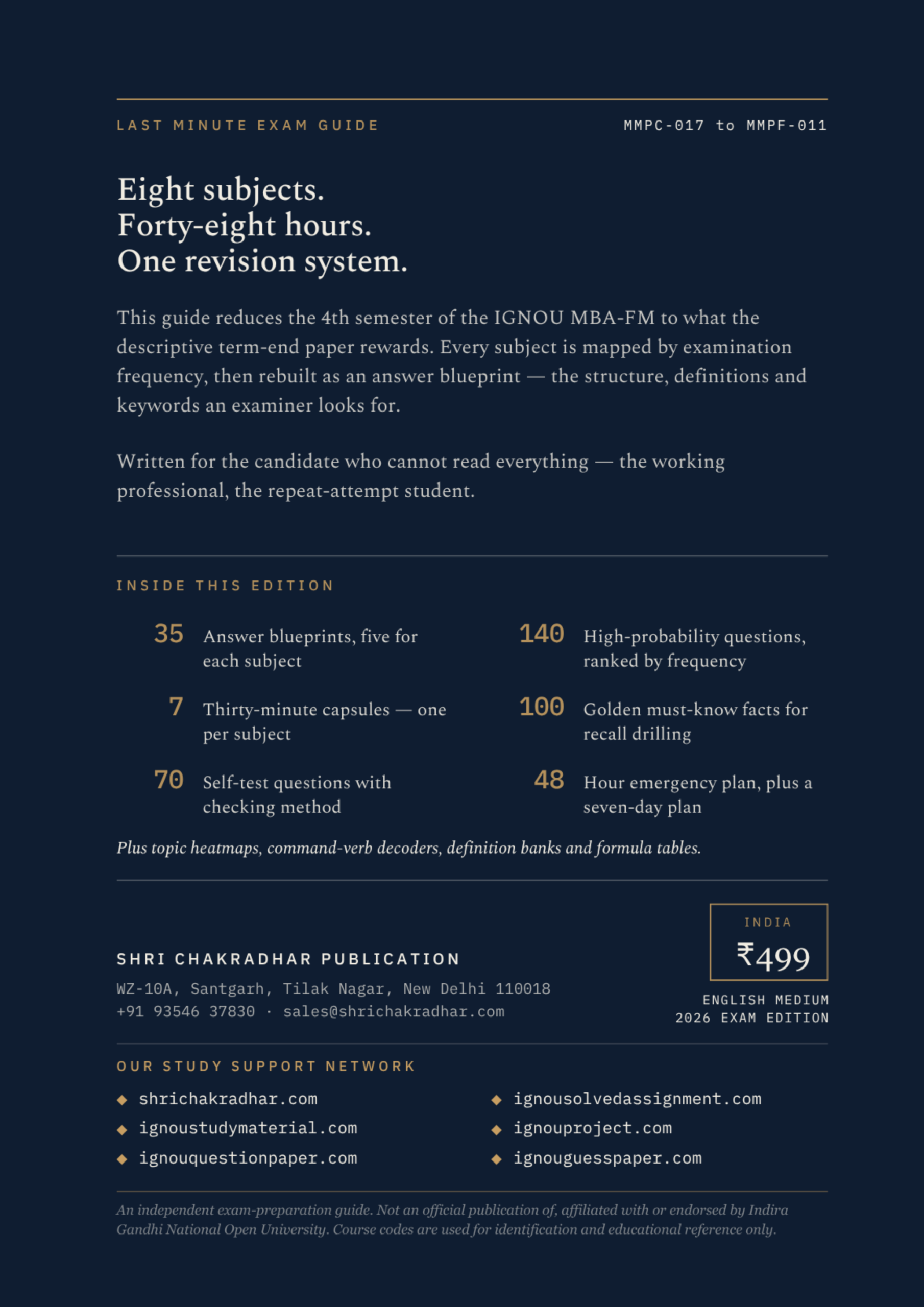
- 128 numbered model Q&As, with 16 selected answers and a separate Exam Note for every course
- 40 reusable Answer Blueprints for frameworks, calculations, regulations, comparisons and financial decisions
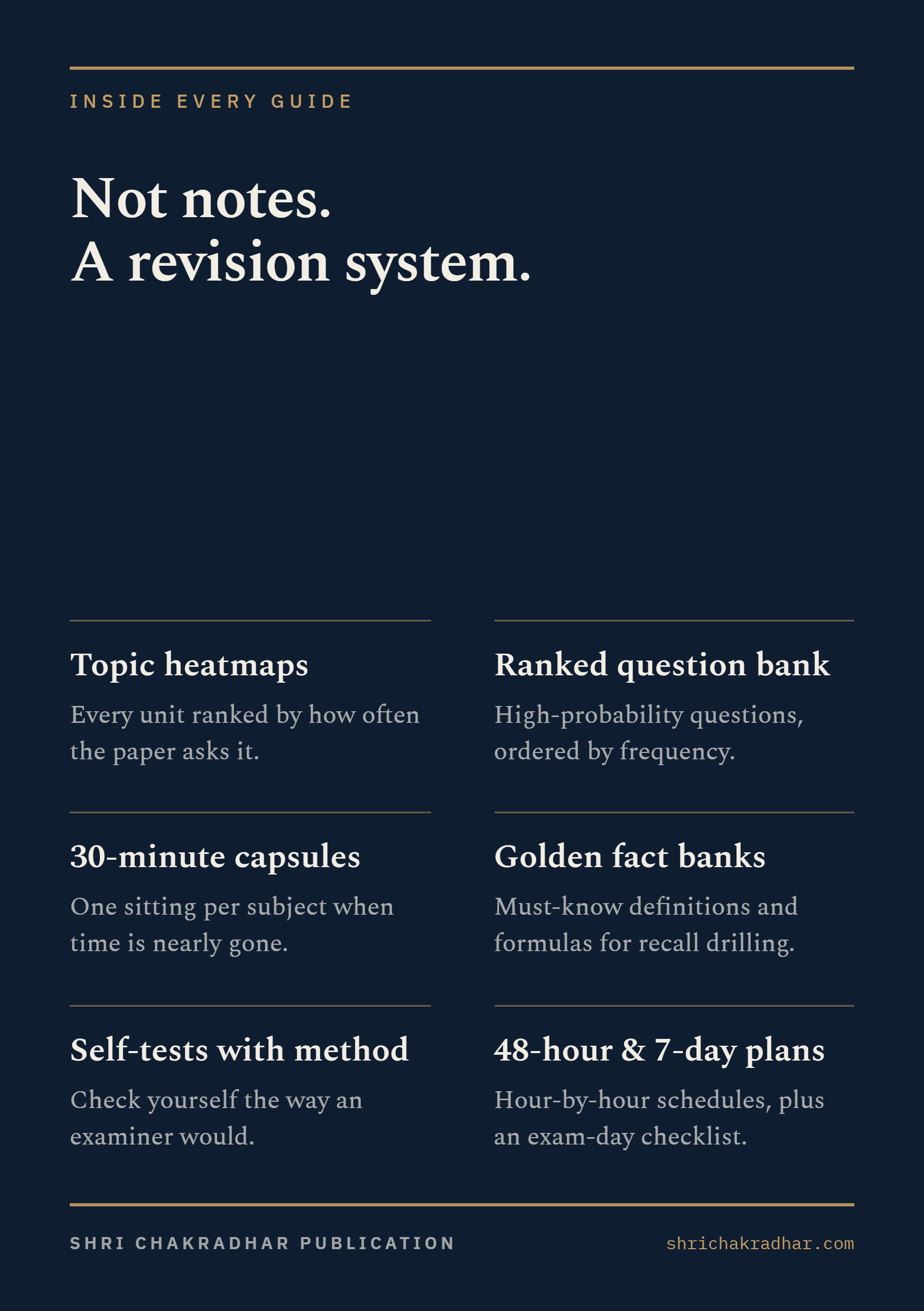
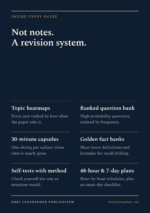
- 24 subject-level navigation aids through eight heatmaps, eight command decoders and eight revision toolkits
- Eight final-30-minute capsules plus reading routes for 48, 24, 12, 6, 3 and 1 hour
- 180 recall checks through 100 golden facts and an 80-question self-test with answers
Suitable for Financial Management distance learners revising theory, formulas, market processes, currency hedges, insurance principles and Indian regulatory frameworks after studying the prescribed blocks.
Written by BK Sahni — IGNOU education expert and author, guiding distance-learning students since 2010.
IGNOU MBA (FM) 4th Semester Book — Strategy, Markets, International Finance and Insurance in One Revision Guide
The IGNOU MBA (FM) 4th Semester Book is a 160-page English Medium Last Minute Exam Guide prepared as the 2027 Exam Edition. It combines MMPC-017, MMPC-018, MMPC-019, MMPC-020, MMPF-004, MMPF-005, MMPF-007 and MMPF-011 for revision before the June and December Term-End Examinations. The title is available on IGNOU Study Material, an independent platform for exam-focused IGNOU help books.
The course mix joins corporate direction with financial-market mechanics, moving from strategy, enterprise, quality and ethics to portfolio construction, currency exposure, issue management, settlement and insurance solvency. The guide therefore changes its answer method from one paper to the next: strategic choices require fit and risk, numerical questions need formulas and interpretation, regulatory answers need statutes and institutions, and insurance responses must connect principles with products and policyholder protection.
About the IGNOU MBA (FM) 4th Semester
The IGNOU MBA (FM) 4th Semester represented in this book contains four common management courses and four Financial Management specialisation papers. MMPC-017 to MMPC-020 supply the strategic, entrepreneurial, quality and ethical setting in which financial decisions are made. MMPF-004, MMPF-005, MMPF-007 and MMPF-011 then concentrate on securities, international finance, Indian equity-market operations and insurance services.
This combination demands several kinds of examination writing. Students may need to explain Ansoff’s growth routes, list Indian enterprise-support institutions, map DMAIC, retain Section 135 figures, calculate standard deviation or a Sharpe ratio, distinguish PPP from IRP, trace an equity trade from order to settlement, or apply utmost good faith and indemnity. One preparation system must therefore support theory, computation, legal detail, market practice and product suitability without treating them as interchangeable.
What This Book Covers
Every subject chapter follows a six-section revision design. The repeated arrangement lets learners locate the same type of resource quickly, while the actual frameworks, formulas, regulations and examples remain specific to the course code.
- Section A — Subject Opener and Topic Heatmap: identifies the paper character, block structure, examination strategy and relative priority of recurring topics.
- Section B — Command Verb Decoder and Golden Rule: explains how verbs such as calculate, justify, distinguish, analyse, describe and evaluate alter the expected response.
- Section C — Five Answer Blueprints: provides reusable structures, short answer skeletons and subject-specific keyword banks.
- Section D — Sixteen High-Probability Q&As: presents numbered model responses, with one separate Exam Note after every answer.
- Section E — Revision Toolkit: gathers thinkers, definitions, formulas or comparison tables and common mistakes for the paper.
- Section F — Thirty-Minute Revision Capsule: reduces the course to five must-remember areas, selected questions, emergency starters and golden keywords.
Across eight chapters, the book contains 40 Answer Blueprints, 128 numbered high-probability Q&As and 128 Exam Notes. It also includes eight topic heatmaps, eight command decoders, eight revision toolkits and eight thirty-minute capsules. The semester section adds a dashboard, a 48-hour emergency plan, six reading routes for 48, 24, 12, 6, 3 and 1 hour, 100 golden facts, an exam-day checklist, 80 self-test questions, an answer key and score interpretation.
Subject-wise Coverage
MMPC-017: Advanced Strategic Management
MMPC-017 frames finance as a consequence of strategic choice. The chapter covers strategy levels; stability, growth and retrenchment; integration; diversification; mergers, alliances; internationalisation; Porter’s industry logic; core competence; VRIO; technology architecture; implementation; scorecard control and governance. Ansoff, Porter, Chandler, Prahalad and Hamel, Barney, Dunning, Bartlett and Ghoshal, Rumelt, Kaplan and Norton provide the named frameworks. Answers state the strategic route, its supporting conditions, its risks and the corporate evidence behind the conclusion.
MMPC-018: Entrepreneurship
MMPC-018 follows a business from opportunity recognition to funding and growth. It covers entrepreneurial functions and types, McClelland’s competencies, women and rural enterprise, idea-generation methods, Drucker’s innovation sources, Timmons’s opportunity-team-resources fit, Osterwalder’s canvas, MVP validation, technical, market and financial feasibility, business plans, institutional support, venture capital, family business, intrapreneurship, social enterprise and industrial sickness. Indian references include Udyam, SIDBI, NABARD, NSIC, KVIC, DICs, PMEGP, CGTMSE, MUDRA, Stand-Up India and Startup India. Its finance connection appears through capital needs, working-capital planning and stage-matched funding.
MMPC-019: Total Quality Management
MMPC-019 links process quality with cost, reliability and managerial control. Deming’s system view and PDCA, Juran’s trilogy, Crosby’s zero defects, Feigenbaum’s cost-of-quality categories, Ishikawa’s seven tools, Shewhart’s variation logic, Shingo’s poka-yoke and Ohno’s wastes form the core. Students revise customer focus, employee involvement, kaizen, brainstorming, process control, Six Sigma and DMAIC, ISO 9001:2015, integration with ISO 14001 and ISO 45001, audit, safety, quality circles, benchmarking and awards. The chapter connects each principle to an operating tool, measurable improvement and the cost consequences of defects.
MMPC-020: Business Ethics and CSR
MMPC-020 brings moral reasoning and statutory responsibility into finance-related decisions. Bentham, Mill, Kant, Aristotle, Rawls, Gilligan, Habermas, Kidder, Friedman, Freeman and Carroll support ethics-versus-law, consequential and duty-based theories, rights, justice, care, discourse, dilemmas and stakeholder analysis. Organisational incentives, whistleblowing, governance, social activism, sustainability, BRSR, GRI and the SDGs also appear. CSR coverage retains the three Section 135 thresholds, the 2% rule, Schedule VII, committee requirements and the handling of unspent amounts. Answers link a philosopher or provision to a managerial case and an ethical conclusion.
MMPF-004: Security Analysis and Portfolio Management
MMPF-004 is the principal valuation and portfolio paper. It covers the securities-market environment, systematic and unsystematic risk, expected return, variance and standard deviation, EIC fundamental analysis, industry life-cycle signals, technical chart patterns, dividend-discount models, Markowitz diversification, the efficient frontier, CAPM, beta, the Security Market Line, Sharpe, Treynor and Jensen measures, benchmark selection, active and passive revision, formula plans, EMH, bond duration and emerging-market challenges. Numerical responses state the formula, define every symbol, show a working table, report units and interpret the investment decision. Worked examples cover return distributions and fund performance.
MMPF-005: International Financial Management
MMPF-005 studies finance across currencies and national borders. The material traces the gold standard, Bretton Woods 1944, the 1971 breakdown and Jamaica 1976; explains balance-of-payments recording; and develops absolute and relative PPP, IRP and covered arbitrage. It covers spot and forward quotations, currency forwards, futures, options and swaps, transaction, translation and economic exposure, international project appraisal, country risk, external commercial borrowings, MNC working capital, export credit, ECGC, ADRs, GDRs and Eurobonds. Importer-buy and exporter-sell examples sit within the FEMA, RBI and managed-float setting.
MMPF-007: Equity Markets
MMPF-007 explains how Indian equity capital is raised, traded, cleared and recorded. It covers the financial system, money and capital markets, systematic and unsystematic risk, IPOs, FPOs, rights issues, private placements, preferential allotment and QIP, the public-issue process, DRHPs, book building, SEBI’s protective and developmental role, investor education, market, limit and stop-loss orders, price-time priority, clearing-corporation novation, margins, T+1 rolling settlement, NSDL, CDSL and dematerialisation. The remaining topics include analysis, portfolio risk, risk measures and free-float index construction.
MMPF-011: Management of Insurance Services
MMPF-011 connects risk pooling with contract law, product design and regulation. The chapter covers utmost good faith, insurable interest, indemnity, subrogation, contribution and proximate cause; the essentials of a valid contract; underwriting factors and decisions; term, whole-life, endowment, money-back, ULIP and annuity products; micro, fire, health, group and crop insurance; claims management; distribution; reinsurance; corporate governance and solvency. The Insurance Act, 1938, Indian Contract Act, 1872 and IRDAI Act, 1999 anchor the statutory side. Named schemes include PMJJBY, PMSBY, AABY, PMFBY and Ayushman Bharat.
MMPC-017 to MMPF-011 at a Glance
| Code | Subject Title | Main Revision Area | What You Take Away |
|---|---|---|---|
| MMPC-017 | Advanced Strategic Management | Growth, competitive advantage, global strategy, execution and control | Strategy judged through fit, risk and evidence |
| MMPC-018 | Entrepreneurship | Opportunity, feasibility, institutions, finance and enterprise growth | Venture choices linked to validation and funding stages |
| MMPC-019 | Total Quality Management | Quality thinkers, tools, Six Sigma, standards and audit | Quality principles converted into measurable methods |
| MMPC-020 | Business Ethics and CSR | Ethical theories, dilemmas, governance, CSR and reporting | Management decisions supported by theory and law |
| MMPF-004 | Security Analysis and Portfolio Management | Risk-return, valuation, diversification, CAPM and performance | Investment calculations followed by interpretation |
| MMPF-005 | International Financial Management | Monetary systems, parity, exposure, hedging and foreign finance | Cross-border finance explained through dates and hedges |
| MMPF-007 | Equity Markets | Capital raising, SEBI, trading, settlement, depositories and indices | Indian market activity traced from issue to demat |
| MMPF-011 | Management of Insurance Services | Insurance principles, products, underwriting, IRDAI and solvency | Risk transfer linked to contracts and protection |
Key Features — All Verified From the Book
- 160-page English Medium edition: four common MBA courses and four Financial Management papers appear in one volume.
- 40 Answer Blueprints: each chapter contributes five structures for theory, calculation, process, comparison and regulation questions.
- 128 numbered model Q&As: sixteen selected revision questions are provided for each of the eight subject codes.
- 128 separate Exam Notes: every answer ends with a reminder about formulas, assumptions, examples, provisions or conclusions.
- 24 course-navigation tools: eight heatmaps, eight command decoders and eight revision toolkits support priority and checking.
- 8 thirty-minute capsules: every subject closes with core concepts, priority prompts, emergency openings and a keyword bank.
- 6 time-window plans: the book specifies approaches for 48, 24, 12, 6, 3 and 1 hour of available revision time.
- 100 golden facts: thinkers, years, formulas, statutes, scheme names and framework chains are collected in the back matter.
- 80 self-test questions: ten MCQs per subject are followed by an answer key and score interpretation.
- Semester-level coordination: a dashboard, a two-day emergency schedule and an exam-day checklist connect the eight papers.
Who Should Use This Book
This combined study guide is intended for IGNOU MBA (FM) 4th Semester learners whose registration matches the eight course codes printed on the cover. It is designed for the stage after the prescribed blocks have been studied, when the remaining challenge is to coordinate management theory with numerical finance, market regulation, foreign-exchange logic and insurance law.
Working professionals and independent distance learners may use the fixed chapter route when study time is fragmented. The book also suits students who recognise concepts but need more discipline in showing formulas, defining variables, naming institutions, retaining dates and provisions, and writing the investor, treasury or policyholder implication after the main answer.
How This Book Helps Students
The guide converts a varied semester into visible answer decisions. Heatmaps suggest where to begin, command decoders identify the requested task and blueprints determine the structure. MMPC papers require frameworks, institutions, tools or statutory logic; MMPF-004 requires formula, working and interpretation; MMPF-005 needs dates, parity conditions and hedge direction; MMPF-007 follows Indian issue and settlement processes; and MMPF-011 combines principles, products, statutes and scheme details.
Model answers demonstrate those methods in finished form. Exam Notes identify omissions such as a missing risk paragraph, undefined variable, absent regulation or unqualified conclusion. Toolkits gather formulas, definitions and contrasts that are easily confused, while capsules, golden facts and MCQs shorten the same knowledge into rapid recall and error correction.
This Exam Guide and IGNOU’s Official Study Material
This Last Minute Exam Guide supplements the prescribed university material; it does not replace it. IGNOU blocks provide the complete unit development, source context and detailed examples needed for foundational learning. Students can download the official IGNOU MBA (FM) study material free in PDF from eGyankosh and should treat those resources as the primary reference for all eight registered courses.
The present book serves the later revision stage. Its selected questions, probability labels and compressed reading routes organise writing practice and retrieval. They neither remove any applicable syllabus area nor reveal the contents of a future Term-End Examination.
Why Choose This Last Minute Exam Guide
The defining feature is the use of different answer engines inside one consistent semester format. Strategy answers state conditions and risks; entrepreneurship answers add institutions and feasibility; TQM answers connect the principle to the tool; ethics answers identify the theory or provision; securities answers show computations; international-finance answers work the parity or hedge; equity-market answers name the regulator and process; and insurance answers apply the principle, statute and product.
The guide also separates full-course learning from last-stage revision. Its shorter schedules assume prior work with the prescribed material, while the probability labels remain study priorities rather than forecasts of a future paper.
About the Author — BK Sahni
BK Sahni (Bhavya Kumar Sahni) is an IGNOU education expert, author, and the founder of Shri Chakradhar Publication Pvt. Ltd. and ignouproject.com, and he has guided 5,00,000+ IGNOU distance-learning students since 2010. He writes the Last Minute Exam Guide series — including this book — building every title on the method he has refined across a decade of IGNOU-focused work: high-probability questions, reusable answer blueprints, topic heatmaps and quick-revision capsules aligned to the current IGNOU exam pattern. He also publishes open-access research-methodology guides for IGNOU students, archived with permanent DOIs on Zenodo and indexed on Google Scholar and ORCID (0009-0005-8092-459X). Learn more about his work at bksahni.com, or browse his complete catalogue of IGNOU books on the Amazon Author Store.
How to Use the Book Effectively
Begin with the semester dashboard and identify whether the weakest area is theory recall, numerical method, statutory detail or process sequence. Read the heatmap and command decoder before studying the five blueprints. Then reproduce selected answers without looking: write strategy conditions, list entrepreneurship institutions, map quality tools, retain CSR figures, calculate portfolio measures, work an importer or exporter hedge, trace the T+1 settlement chain and apply insurance principles to the product named.
Choose the longest reading route compatible with preparation already completed. Extend whole-paper practice through IGNOU previous years solved question papers, and consult free IGNOU study support and resources on IGNOU Project where supplementary guidance is needed. Attempt all 80 self-test questions, return to the relevant Section E after each error and reserve the thirty-minute capsule for immediate pre-paper recall.
Frequently Asked Questions
Which subjects are included in this IGNOU MBA (FM) 4th Semester Book?
The book covers MMPC-017 Advanced Strategic Management, MMPC-018 Entrepreneurship, MMPC-019 Total Quality Management, MMPC-020 Business Ethics and CSR, MMPF-004 Security Analysis and Portfolio Management, MMPF-005 International Financial Management, MMPF-007 Equity Markets, and MMPF-011 Management of Insurance Services. Every code has an independent six-section chapter.
Is this one combined volume or eight separate course books?
It is one combined 160-page English Medium book. The eight subjects remain separated by code and chapter, but they use the same revision route from topic heatmap to final capsule. The product is therefore one bound 2027 Exam Edition rather than a bundle of eight individual helpbooks.
Can the guide be used for both June and December Term-End Examinations?
Yes. Its frameworks, calculations, statutory checkpoints, market-process maps and recall tools can support preparation before either June or December Term-End Examination session. The probability symbols indicate revision priority only; they do not confirm the questions that will appear in a particular paper.
Does it include solved assignments, full PYQ papers or a separate guess paper?
No. Solved assignments, complete previous-year question papers, handwritten submissions and a standalone guess paper are not included. The book instead provides 128 numbered model Q&As, 40 Answer Blueprints, eight revision toolkits, 100 golden facts and an 80-question self-test for structured examination revision.
Can this finance revision book replace IGNOU’s prescribed study blocks?
No. The guide condenses selected topics into answer structures, calculations and rapid-revision tools, so it cannot replace the detailed explanations and complete unit progression in the prescribed material. Use the official blocks for foundational study and this book for practice, retrieval, interpretation and final consolidation.
Who should use this 4th Semester Financial Management edition?
The intended reader is an IGNOU MBA (FM) learner registered for the eight printed codes and already working through the syllabus. It is particularly relevant to employed students and independent distance learners who need one method across management theory, securities analysis, international finance, equity-market practice and insurance services.
How should the 48-hour, 12-hour and 1-hour plans be selected?
Select the route according to prior preparation as well as available time. Longer plans include wider chapter reading, written reproduction and self-testing; shorter options increasingly concentrate on selected questions, blueprints, capsules and golden facts. The 1-hour route is a final memory sweep and cannot teach eight courses from the beginning.
Are the 128 high-probability questions predictions of the next examination?
No. They are study-priority questions based on earlier examination patterns and the prominence of topics in the learning material. They help distribute limited revision time and demonstrate answer form, but IGNOU may assess any relevant part of the current syllabus.
Should the latest MBA (FM) course structure be verified before ordering?
Yes. Check www.ignou.ac.in for the current programme structure, registered course combination, date sheet, study material and examination instructions. This edition follows the MMPC-017, MMPC-018, MMPC-019, MMPC-020, MMPF-004, MMPF-005, MMPF-007 and MMPF-011 arrangement printed in the book. The current official notification remains the final reference for registration decisions.
Important Note on Syllabus Verification
IGNOU periodically updates its programme structure, assignment requirements, examination schedule and study material. Before purchasing and while preparing, students should verify the latest MBA (FM) syllabus, course list, date sheet and official instructions on the official IGNOU website (www.ignou.ac.in). This book is aligned to the MMPC-017, MMPC-018, MMPC-019, MMPC-020, MMPF-004, MMPF-005, MMPF-007 and MMPF-011 structure and refreshed as an annual exam edition, but official IGNOU sources are always the final authority.
Non-Affiliation Disclaimer
ignoustudymaterial.com is an independent educational publishing platform. This book and this website are not officially affiliated with, endorsed by, or operated by the Indira Gandhi National Open University (IGNOU). Course codes such as MMPC-017, MMPC-018, MMPC-019, MMPC-020, MMPF-004, MMPF-005, MMPF-007 and MMPF-011 are used solely to identify the subjects the book covers. IGNOU’s official study material and notifications remain the primary and authoritative sources for the programme.
Get Your Copy
Choose this combined Financial Management revision guide when one organised source is more practical than scattered notes for eight papers. Keep the prescribed blocks as the learning base, complete numerical workings independently and use the capsules only for final retrieval. For digital access, get the IGNOU MBA (FM) 4th Semester Book (MMPC-017 to MMPF-011) — Combined Last Minute Exam Study Guide as a soft-copy PDF on WhatsApp.
| Weight | 250 g |
|---|---|
| Dimensions | 22 × 16 × 1 cm |





Reviews
There are no reviews yet.