
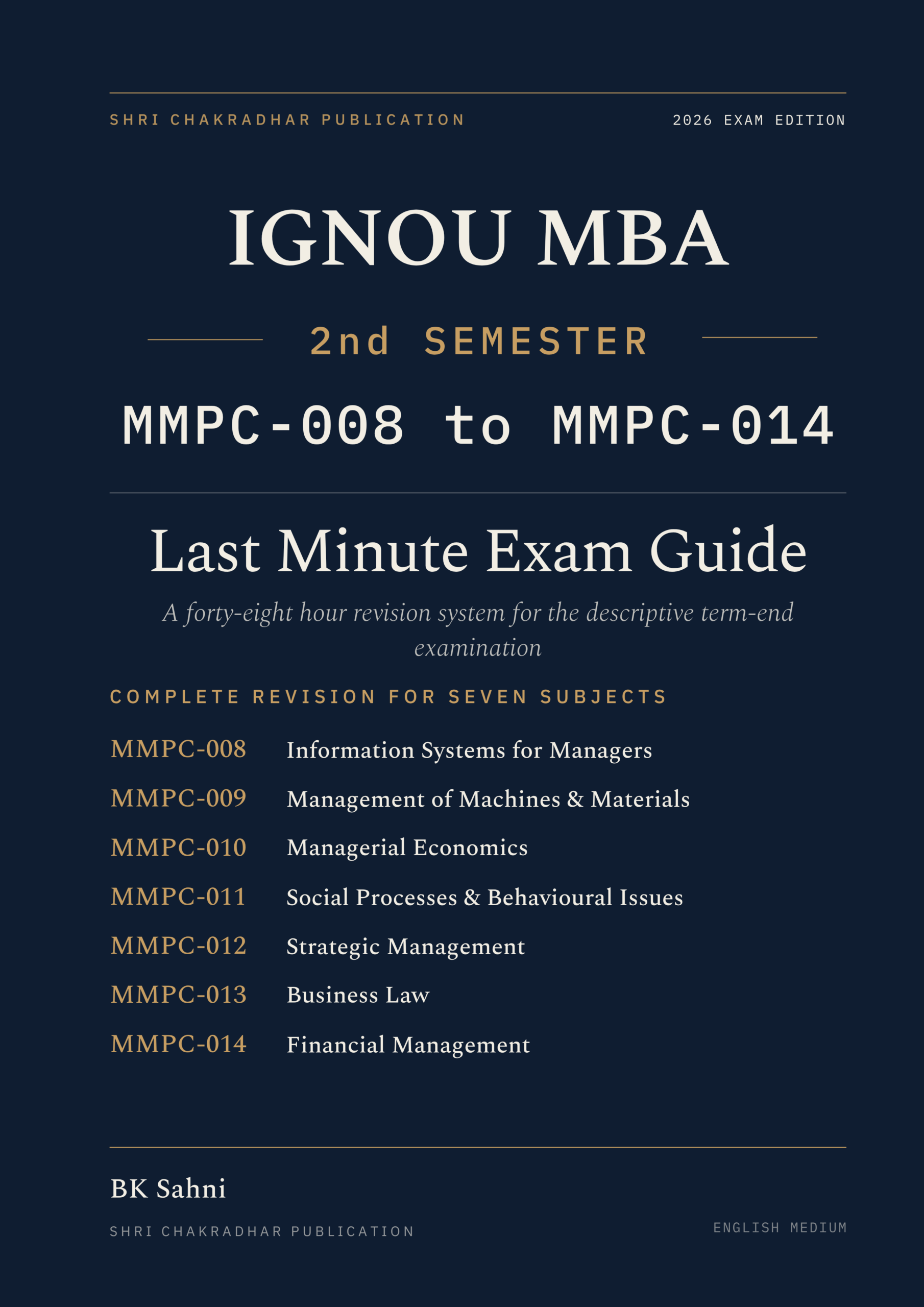

IGNOU MBA 2nd Semester Book (MMPC-008 to MMPC-014) — Combined Last Minute Exam Study Guide
Original price was: ₹449.00.₹249.00Current price is: ₹249.00.
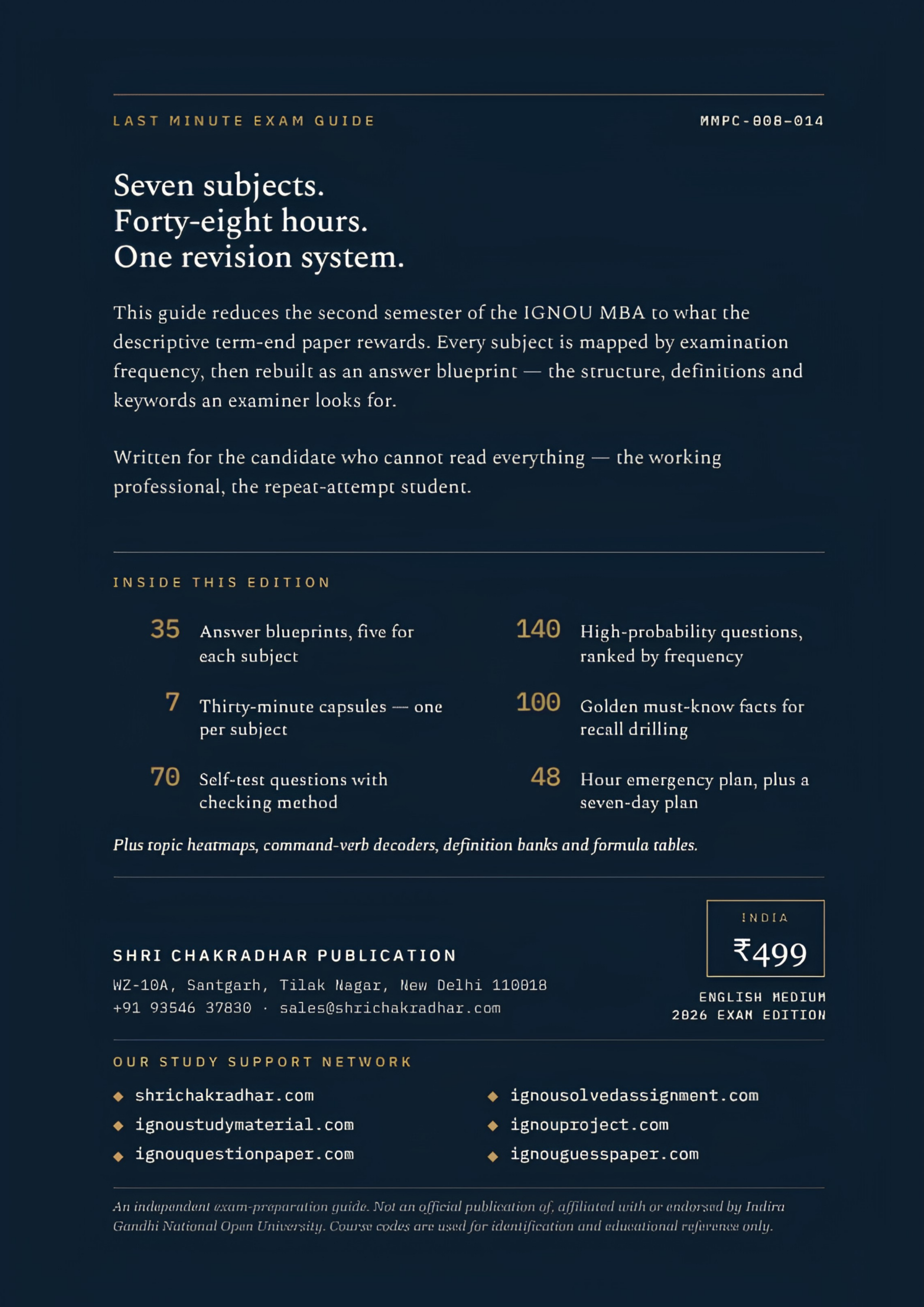
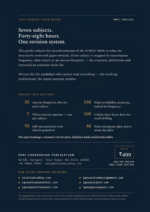
Seven specialised MBA papers become one practical final-revision route. The 2026 English Medium IGNOU MBA 2nd Semester Last Minute Exam Study Guide combines MMPC-008 to MMPC-014 in a single 156-page volume for June and December Term-End Examination preparation.
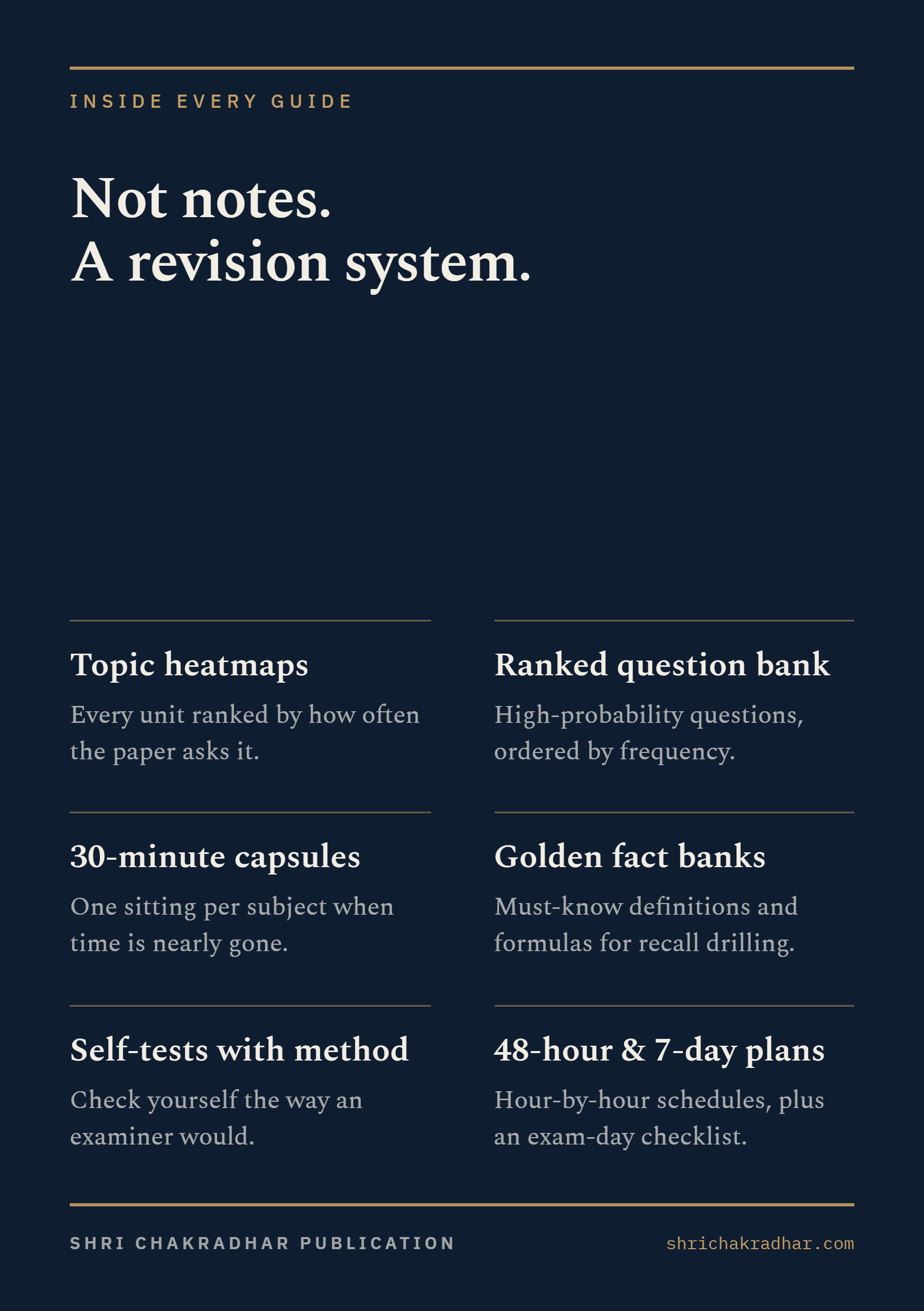
- 140 high-probability Q&As with model answers and an Exam Note after every response
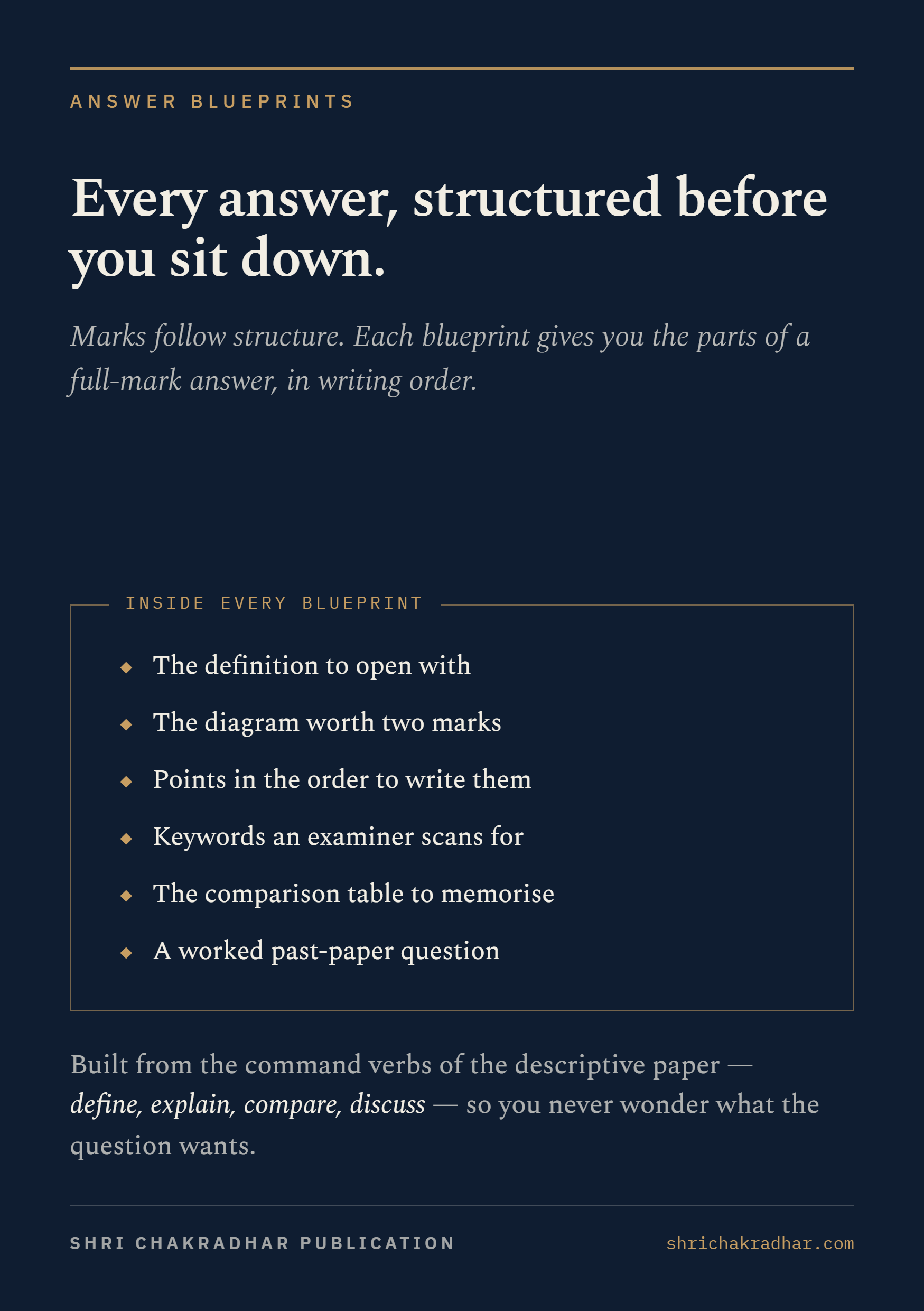
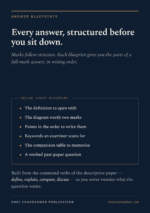
- 35 reusable Answer Blueprints covering diagrams, legal provisions, formulas, theories and case applications
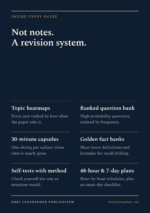
- 7 topic heatmaps and 7 command-verb decoders for priority setting and question interpretation
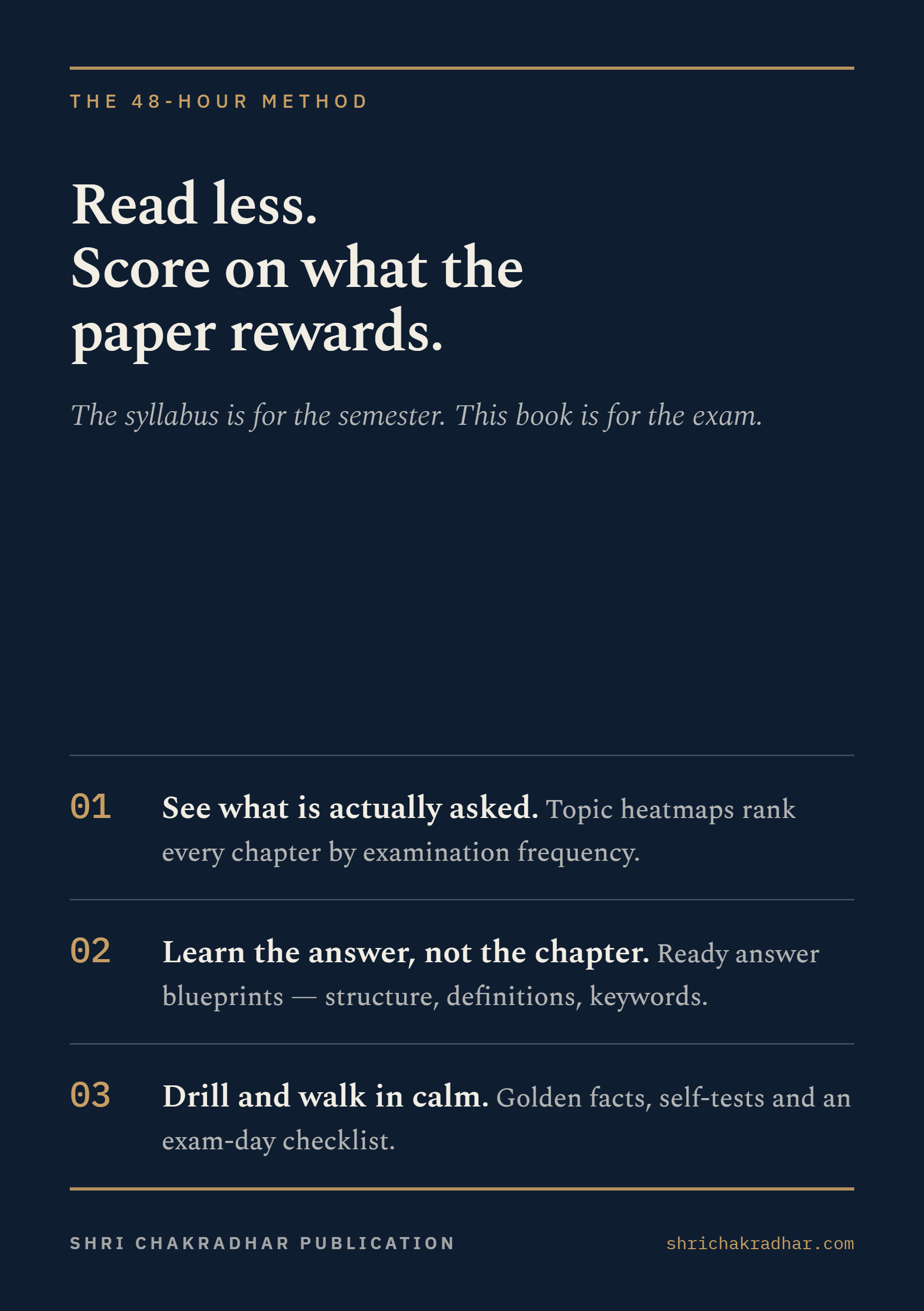
- 7 thirty-minute capsules plus 48-hour, 24-hour, 12-hour, 6-hour, 3-hour and 1-hour reading routes
- 100 golden facts and a 70-question self-test with an answer key for semester-wide recall
Useful for distance learners and working professionals revising information systems, operations, economics, behaviour, strategy, law and finance alongside official study material.
Written by BK Sahni — IGNOU education expert and author, guiding distance-learning students since 2010.
IGNOU MBA 2nd Semester Book — Seven Technical, Legal and Managerial Papers in One Revision Guide
The IGNOU MBA Second Semester Book is a 156-page English Medium revision volume covering MMPC-008 to MMPC-014 for the 2026 Exam Edition. Available on IGNOU Study Material, an independent platform for exam-focused IGNOU help books, it brings Information Systems, Operations, Managerial Economics, Organisational Behaviour, Strategy, Business Law and Financial Management into one coordinated Last Minute Exam Guide. The book is intended for the revision stage before the June and December Term-End Examinations, not for first-time study of the entire syllabus.
Its design responds to the unusual breadth of this semester. Students must move from MIS diagrams and EOQ calculations to economic curves, behavioural theorists, strategic matrices, statutory sections and finance formulas. The guide converts those changing requirements into a repeated six-section chapter system, supported by 35 Answer Blueprints, 140 high-probability Q&As, seven capsules, 100 golden facts and a 70-question self-test.
About the IGNOU MBA 2nd Semester
The IGNOU MBA Second Semester develops the analytical and functional base needed for later management courses. MMPC-008 examines information systems used in decisions; MMPC-009 studies production, facilities and materials; MMPC-010 applies economic reasoning to demand, cost, markets and pricing; and MMPC-011 explains individual and group behaviour. MMPC-012 moves to competitive and corporate strategy, MMPC-013 introduces the legal environment of business, and MMPC-014 covers investment, financing, dividend and working-capital decisions.
This combination requires more than one answer style. Technical questions may need diagrams, operations and finance problems require formulas with units, law answers depend on Acts and sections, and behavioural or strategy responses need attributed models plus applications. The book preserves these differences while giving every course the same navigational sequence.
What This Book Covers
This guide covers the seven core courses MMPC-008, MMPC-009, MMPC-010, MMPC-011, MMPC-012, MMPC-013 and MMPC-014. Each subject chapter is arranged into six fixed parts, allowing a student to locate priorities, answer patterns, model content and final recall material without relearning the book’s structure.
- Section A — Subject Opener and Topic Heatmap: states the course blocks, paper style, examination approach and topic priority estimates.
- Section B — Command Verb Decoder: explains what instructions such as discuss, calculate, distinguish, evaluate, illustrate and critically examine require.
- Section C — Five Answer Blueprints: supplies transferable frameworks with sample skeletons and subject-specific keywords.
- Section D — Twenty High-Probability Q&As: demonstrates complete descriptive, comparative, diagram-based, legal and numerical answer patterns.
- Section E — Revision Toolkit: collects thinkers, definitions, formulas, statutes, comparisons and common examination mistakes.
- Section F — Thirty-Minute Revision Capsule: compresses five essential concepts, three priority questions, emergency answer starters and golden keywords.
The verified totals are 35 blueprints, 140 model Q&As and 140 accompanying Exam Notes. The back matter adds 100 cross-subject facts, 70 self-test questions with an answer key and an exam-day checklist. Time-based reading routes are supplied for 48 hours, 24 hours, 12 hours, 6 hours, 3 hours and 1 hour, so the same book can support either planned revision or a compressed final review.
Subject-wise Coverage
MMPC-008: Information Systems for Managers
MMPC-008 is built around diagrams, system levels and business application. It covers MIS, DSS, TPS, EIS, Anthony’s Triangle, ERP, SDLC, DBMS, data warehousing, data mining, computer networks, system analysis, programming languages, cybersecurity, cloud computing, Big Data, IoT, blockchain and the strategic use of IT. Named references include Davis and Olson, Gorry and Scott Morton, E.F. Codd, Alan Turing, John McCarthy and Michael Porter. The answer method repeatedly links technical components to managerial decisions and encourages labelled block diagrams, DFDs, hierarchy charts and comparison tables.
MMPC-009: Management of Machines & Materials
MMPC-009 organises operations topics through production systems, layouts, networks, inventory and quality frameworks. Learners revise EOQ, ABC, VED and FSN analysis, PERT and CPM, capacity, facility location, work study, material handling, MRP, aggregate planning, JIT, Kanban, Lean, TQM, Six Sigma, Value Engineering, standardisation and codification. Formula-first blueprints explain EOQ and capacity questions, while process frameworks cover DMAIC, MRP and project networks. The chapter also associates Taylor, Ford, Taiichi Ohno, Harris, Lawrence Miles, Deming, Juran, Crosby, Ishikawa and Orlicky with their respective contributions.
MMPC-010: Managerial Economics
MMPC-010 converts economic ideas into diagrams, formulas and pricing decisions. Its coverage includes the law of demand, determinants and exceptions, price, income and cross elasticity, demand forecasting, production functions, variable proportions, returns to scale, cost curves, break-even analysis, market structures and pricing methods. The material distinguishes perfect competition, monopoly, monopolistic competition and oligopoly, and revises Chamberlin, Sweezy, Cournot, Bertrand, Baumol and Williamson. Indian examples are used to explain penetration, skimming, price discrimination and market behaviour, while the blueprints remind students to draw curves and interpret numerical answers.
MMPC-011: Social Processes & Behavioural Issues
MMPC-011 emphasises theorist attribution and model application. It covers the evolution and scope of Organisational Behaviour, personality through OCEAN, values, attitudes, perception, attribution, classical, operant and social learning, and motivation through Maslow, Herzberg, McGregor, Vroom and McClelland. Group development, conflict, stress, empowerment, OCB, diversity, positive psychology and emotional intelligence are also included. The toolkits connect Tuckman’s stages, Thomas-Kilmann styles, Selye’s GAS, Organ’s citizenship dimensions, Goleman’s components and Seligman’s PERMA model to diagrams, comparisons and Indian organisational examples.
MMPC-012: Strategic Management
MMPC-012 is organised around frameworks that students can draw and apply. The chapter covers vision, mission, objectives, environmental scanning, SWOT and TOWS, PESTLE, Porter’s Five Forces, generic strategies and value chain, Ansoff’s product-market grid, the BCG Matrix, corporate strategies, mergers, alliances, implementation, governance, the Balanced Scorecard, core competence, strategic control and Blue Ocean Strategy. Creator names and years are integrated throughout, including Porter, Ansoff, Chandler, Mintzberg, Henderson, Prahalad and Hamel, Kaplan and Norton, and Kim and Mauborgne. Indian cases illustrate portfolio, acquisition, competition and implementation decisions.
MMPC-013: Business Law
MMPC-013 trains learners to state the full Act name, year and relevant section before discussing a legal rule. Coverage includes the Indian Contract Act 1872, Companies Act 2013, Partnership Act 1932, LLP Act 2008, Sale of Goods Act 1930, Negotiable Instruments Act 1881, Consumer Protection Act 2019, FEMA 1999, IBC 2016, Competition Act 2002, intellectual property laws, environmental legislation and the DPDP Act 2023. The chapter supplies statutory definitions, rights and remedies, process explanations and comparisons such as condition versus warranty, partnership versus LLP versus company, and indemnity versus guarantee.
MMPC-014: Financial Management
MMPC-014 brings together finance concepts and stepwise numerical work. It covers the scope of financial management, wealth maximisation, time value of money, risk and return, CAPM, bond and equity valuation, cost of capital, WACC, capital budgeting, working capital, financial markets, sources of finance, capital structure, leverage, dividend theories, behavioural finance and restructuring. Formula tables and model calculations address PV, FV, annuities, NPV, IRR, PI, WACC, DOL, DFL and DCL. Theory sections attribute MM, Walter, Gordon, Sharpe, Markowitz, Myers and Kahneman, while each calculation ends with a decision-oriented interpretation.
MMPC-008 to MMPC-014 at a Glance
| Code | Subject Title | Main Revision Area | What You Take Away |
|---|---|---|---|
| MMPC-008 | Information Systems for Managers | MIS, databases, systems development and emerging technology | Diagram-led explanations connected to managerial decisions |
| MMPC-009 | Management of Machines & Materials | Operations, inventory, projects, JIT and quality | Formulas, process diagrams and operations comparisons |
| MMPC-010 | Managerial Economics | Demand, production, costs, markets and pricing | Economic curves, formulas and business interpretation |
| MMPC-011 | Social Processes & Behavioural Issues | Personality, learning, motivation, groups and conflict | Theorist-based models with organisational application |
| MMPC-012 | Strategic Management | Environmental analysis, strategy choice and control | Drawable frameworks and Indian strategic cases |
| MMPC-013 | Business Law | Contracts, companies, consumer law, IPR and regulation | Act-year-section answers with cases and remedies |
| MMPC-014 | Financial Management | Investment, financing, dividend, leverage and working capital | Formula-first calculations followed by financial decisions |
Key Features — All Verified From the Book
- 7 MBA Second Semester courses combined in one English Medium revision volume.
- 156 pages in the 2026 MBA Exam Edition.
- 35 Answer Blueprints, with five frameworks written specifically for each subject.
- 140 high-probability Q&As, comprising twenty model questions and answers per course.
- 140 Exam Notes that flag formulas, diagrams, theorists, statutes, distinctions or common errors.
- 7 topic heatmaps and 7 command decoders for priority planning and answer-format selection.
- 7 revision toolkits and 7 thirty-minute capsules for progressively shorter review.
- 6 time-based reading routes designed for preparation windows ranging from 48 hours to 1 hour.
- 100 golden must-know facts distributed across all seven subjects.
- 70 self-test questions with an answer key, giving ten recall checks per course.
- An exam-day checklist covering preparation, writing approach and final review.
Who Should Use This Book
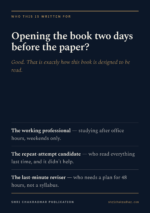
This book is intended for IGNOU MBA Second Semester students who have already started the prescribed material and now need a controlled revision system. It is useful for distance learners switching repeatedly between technical diagrams, operations formulas, economics graphs, behavioural theories, strategic matrices, legal provisions and finance calculations. Working professionals and students with fragmented study time may use the time-based routes to select a realistic reading depth.
The guide is also appropriate for learners who know a topic but are unsure how to present it. Its blueprints show when to define, compare, draw, cite an Act, identify a theorist, show numerical working or add an Indian application.
How This Book Helps Students
The guide helps by separating revision into decisions that can be acted upon. Heatmaps indicate where the book suggests giving more attention; command decoders translate examiner verbs into expected answer forms; and blueprints provide repeatable structures rather than isolated notes. A student can therefore approach a DSS comparison, EOQ numerical, elasticity diagram, motivation theory, BCG application, contract-law answer or NPV problem with an appropriate sequence.
The 140 Q&As then demonstrate those sequences in context. Revision toolkits consolidate names, formulas, statutes and comparisons, while capsules reduce each paper to a final half-hour map. The golden facts and self-test expose weak recall before the examination.
This Exam Guide and IGNOU’s Official Study Material
This Last Minute Exam Guide supplements rather than replaces the prescribed university material. IGNOU blocks provide full explanations, unit progression, examples and academic context. Students can download the official IGNOU MBA study material free in PDF from eGyankosh and should treat those resources as the primary basis for learning.
The present book becomes useful after that foundation is established. It reorganises selected concepts around revision priorities, answer construction and recall. Since topic probabilities are guidance rather than certainty, learners should not treat the highlighted list as the entire examinable syllabus.
Why Choose This Last Minute Exam Guide
The book’s main distinction is its subject-sensitive revision engineering. MMPC-008 asks for diagrams and system levels; MMPC-009 and MMPC-014 demand formulas and units; MMPC-010 requires curves and interpretation; MMPC-011 depends on theorist attribution; MMPC-012 relies on named frameworks; and MMPC-013 requires Acts, years and sections. Each chapter adapts the common six-part architecture to these different demands.
It is also explicit about limitations. The emergency plan assumes earlier reading, the probability labels are not promises, and the prescribed IGNOU material remains authoritative. The combined format reduces scattered revision without claiming to replace full study.
About the Author — BK Sahni
BK Sahni (Bhavya Kumar Sahni) is an IGNOU education expert, author, and the founder of Shri Chakradhar Publication Pvt. Ltd. and ignouproject.com, and he has guided 5,00,000+ IGNOU distance-learning students since 2010. He writes the Last Minute Exam Guide series — including this book — building every title on the method he has refined across a decade of IGNOU-focused work: high-probability questions, reusable answer blueprints, topic heatmaps and quick-revision capsules aligned to the current IGNOU exam pattern. He also publishes open-access research-methodology guides for IGNOU students, archived with permanent DOIs on Zenodo and indexed on Google Scholar and ORCID (0009-0005-8092-459X). Learn more about his work at bksahni.com, or browse his complete catalogue of IGNOU books on the Amazon Author Store.
How to Use the Book Effectively
Start with the Semester-at-a-Glance dashboard and identify the paper requiring the most practice. Read its heatmap, then study the command decoder before attempting a question. Learn the logic of all five blueprints, but rewrite answers in your own words. Draw the diagrams recommended in Information Systems, Operations, Economics, Behaviour and Strategy. In Business Law, write the Act name, year and section. In Operations and Finance, state the formula, define variables, substitute values, include units and interpret the result.
Use the 48-hour route only after prior study; shorter routes should reduce depth, not replace understanding. Extend practice with IGNOU previous years solved question papers, and consult free IGNOU study support and resources on IGNOU Project where additional guidance is needed. Finish with the 100 facts, answer the 70 self-test items, review errors and reserve the relevant capsule for the final thirty minutes.
Frequently Asked Questions
Which subjects are included in this IGNOU MBA Second Semester Book?
The book covers MMPC-008 Information Systems for Managers, MMPC-009 Management of Machines & Materials, MMPC-010 Managerial Economics, MMPC-011 Social Processes & Behavioural Issues, MMPC-012 Strategic Management, MMPC-013 Business Law and MMPC-014 Financial Management. Each course has its own six-section revision chapter.
Is this one combined guide or a set of seven separate books?
It is one combined 156-page book. All seven courses appear as separate chapters inside the same English Medium 2026 Exam Edition. The repeated structure lets students carry one volume while still reaching a dedicated heatmap, five blueprints, twenty Q&As, toolkit and capsule for each code.
Can this guide be used for June and December Term-End Examinations?
Yes. The book is designed for revision before the June and December Term-End Examinations. It supports descriptive, diagram-based, legal and numerical preparation, but it does not confirm the questions that will appear. The probability ratings are prioritisation estimates, and any applicable syllabus topic may be examined.
Does it include solved assignments, full previous-year papers or a separate guess paper?
No. The volume does not contain solved assignments, complete previous-year question papers or a standalone guess paper. It provides 140 selected high-probability Q&As, 35 Answer Blueprints, toolkits and self-testing instead. Assignment solutions and full paper-practice resources must be obtained separately.
Can the book replace the official IGNOU MBA study material?
No. This is a condensed revision companion and cannot substitute for the prescribed blocks. The official material explains the complete units and should be read first. Use the guide to organise recall, practise answer presentation and revisit formulas or frameworks after the underlying concepts have been studied.
Who should consider this revision book?
The suitable buyer is an MBA Second Semester learner seeking one organised route across seven different paper styles. It is especially relevant to working professionals, distance learners without regular answer-writing supervision and students who need help choosing between diagrams, tables, statutes, attributed theories and formula-based working.
How should the six time-based reading plans be selected?
Choose the route that matches preparation already completed. The 48-hour plan includes broad practice, whereas the 24-, 12-, 6- and 3-hour options progressively emphasise blueprints and capsules. The 1-hour route is limited to the 100 golden facts and checklist. None of these schedules is intended to replace first-time syllabus study.
Are the 140 high-probability questions confirmed for the examination?
No. The questions and heatmap ratings are revision guidance based on past-paper analysis and topic prominence as described in the book. They help allocate limited time but do not predict a particular examination paper. Students should understand the wider course content and avoid skipping all topics outside the priority list.
Should students verify the latest syllabus before using the 2026 edition?
Yes. Students should confirm the current MBA course structure, date sheet, examination instructions and study material on www.ignou.ac.in. This check ensures that MMPC-008 to MMPC-014 apply to the learner’s admission and examination cycle and that no later university change affects preparation.
Important Note on Syllabus Verification
IGNOU periodically updates its programme structure, assignment requirements, examination schedule and study material. Before purchasing and while preparing, students should verify the latest MBA syllabus, course list, date sheet and official instructions on the official IGNOU website (www.ignou.ac.in). This book is aligned to the MMPC-008 to MMPC-014 structure and refreshed as an annual exam edition, but official IGNOU sources are always the final authority.
Non-Affiliation Disclaimer
ignoustudymaterial.com is an independent educational publishing platform. This book and this website are not officially affiliated with, endorsed by, or operated by the Indira Gandhi National Open University (IGNOU). Course codes such as MMPC-008 to MMPC-014 are used solely to identify the subjects the book covers. IGNOU’s official study material and notifications remain the primary and authoritative sources for the programme.
Get Your Copy
Select this combined guide when you need a single revision system for all seven MBA Second Semester papers. Pair it with the prescribed blocks, practise the subject-specific blueprints and use the capsules only after fuller preparation. For digital access, get the IGNOU MBA Second Semester Book (MMPC-008 to MMPC-014) — Combined Last Minute Exam Study Guide as a soft-copy PDF on WhatsApp.
| Weight | 250 g |
|---|---|
| Dimensions | 22 × 16 × 1 cm |



Reviews
There are no reviews yet.