
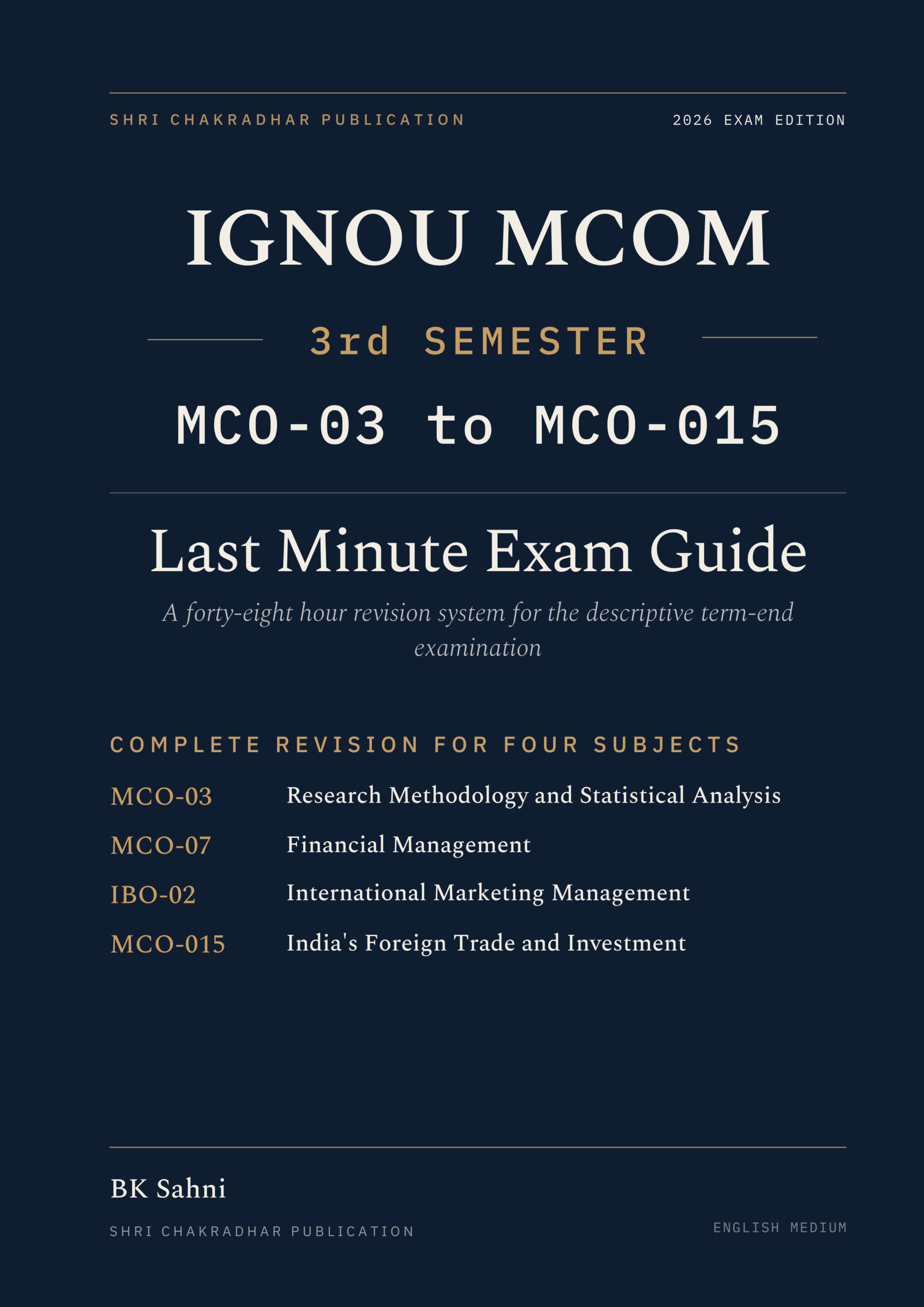
IGNOU M.Com 3rd Semester Book (MCO-03 to MCO-015) — Combined Last Minute Exam Study Guide
Original price was: ₹499.00.₹249.00Current price is: ₹249.00.
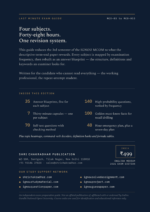
Move from research design and financial calculation to export-market choices and India’s trade policy through one controlled 3rd Semester revision route. This 2027 English Medium IGNOU M.Com Last Minute Exam Guide combines MCO-03, MCO-07, IBO-02 and MCO-015 in a single 157-page volume.
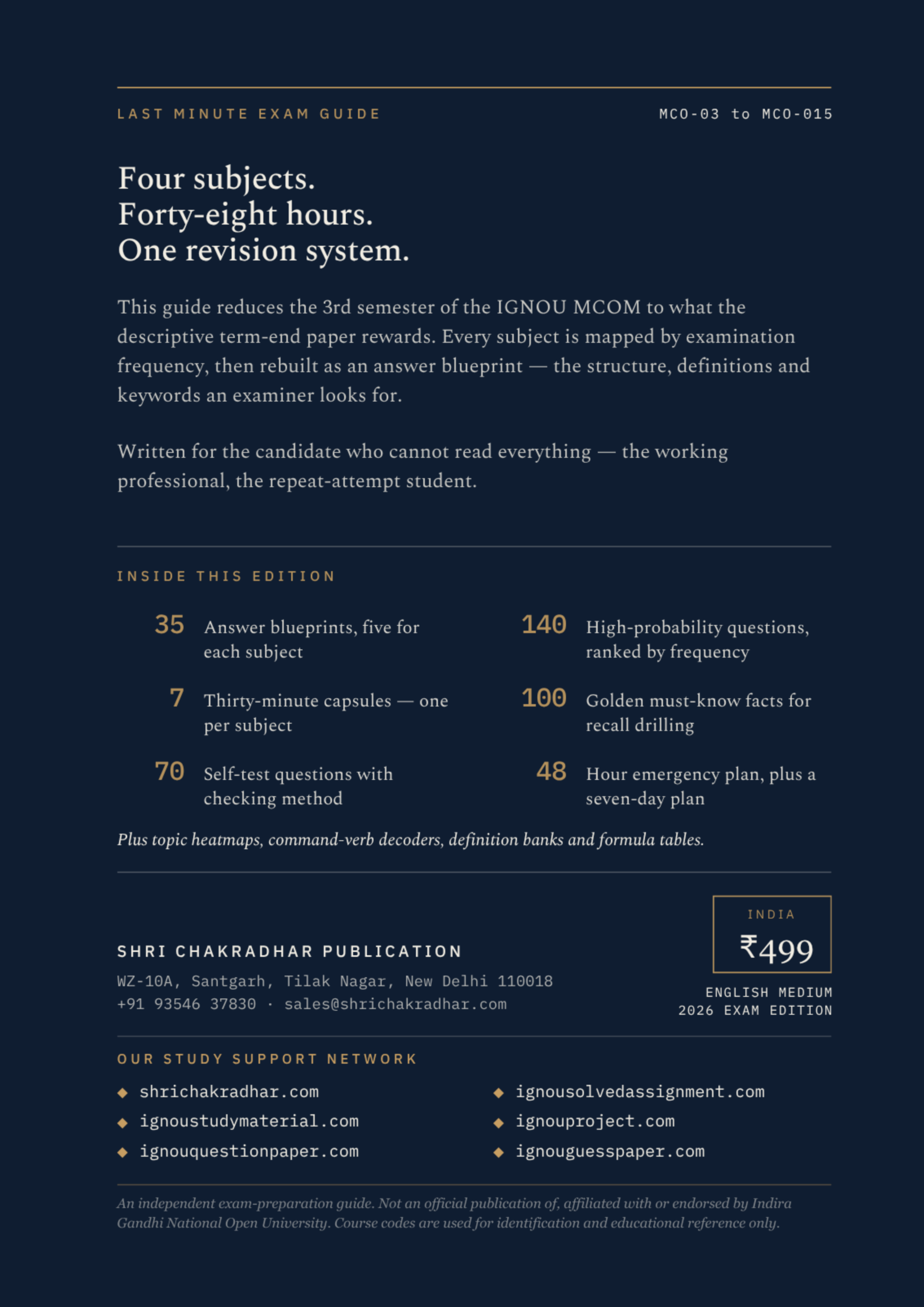
- 100 numbered model Q&As, with 25 selected responses per course and an individual Exam Note after every answer
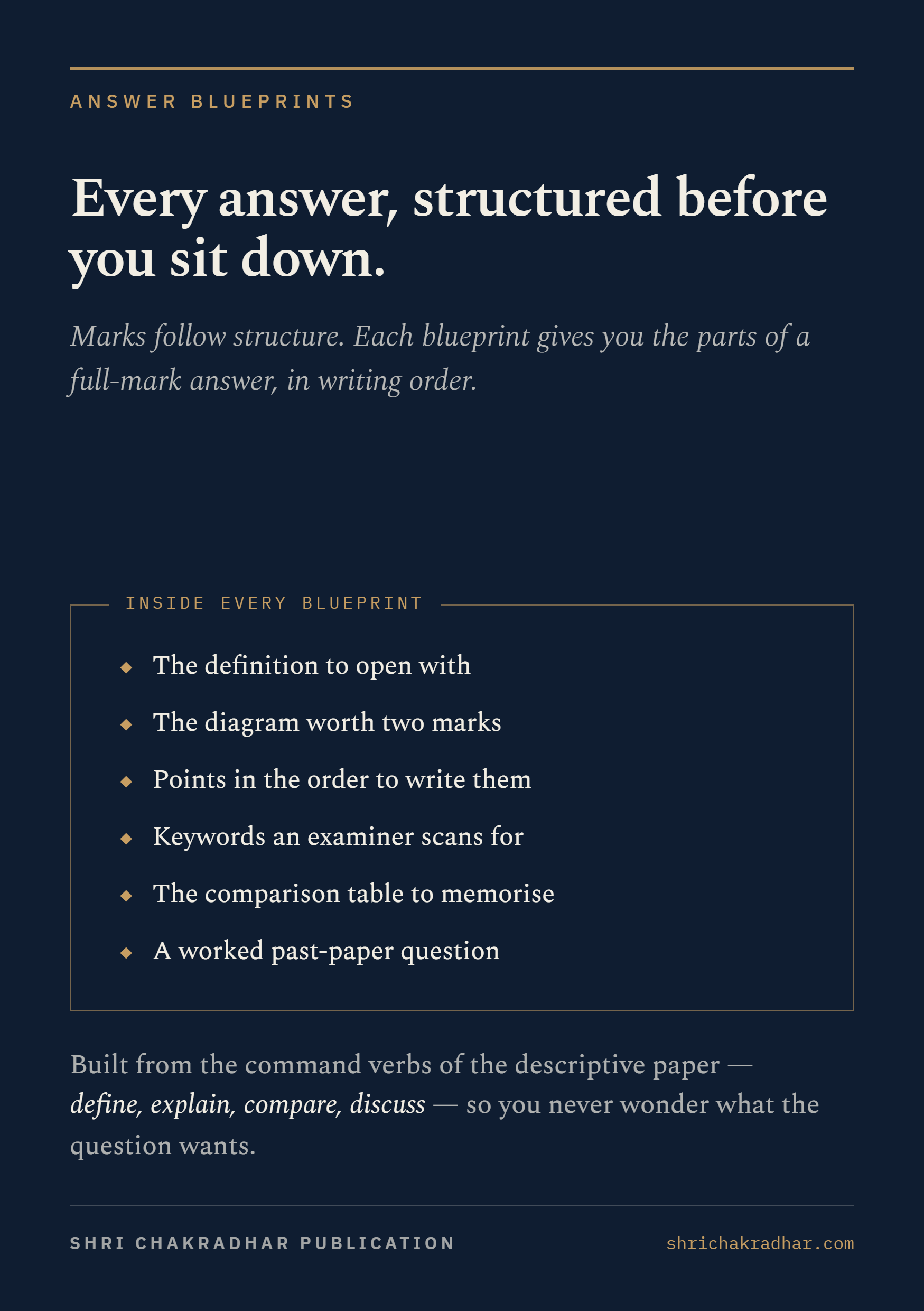
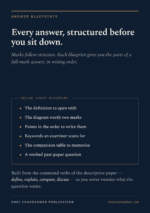
- 20 course-matched Answer Blueprints for methodology, numerical work, international marketing and trade-policy analysis
- 16 case-based exercises covering research design, financial decisions, export marketing and Indian foreign-trade situations
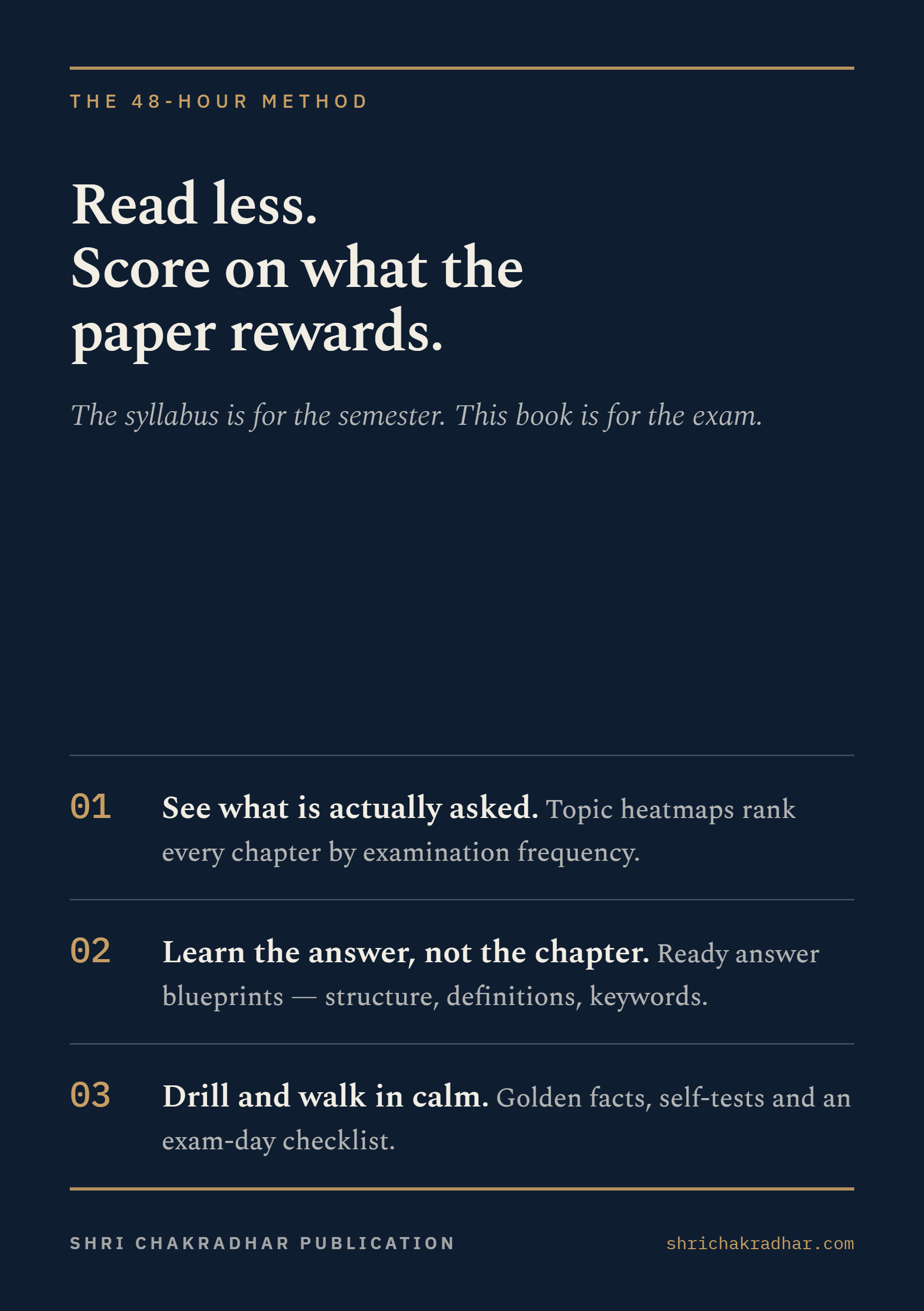
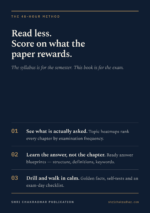
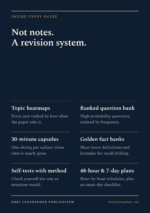
- Four thirty-minute capsules and six reading routes for preparation windows from 48 hours down to 1 hour
- 140 recall checks through 100 golden facts and 40 self-test questions with an answer key
Suitable for M.Com distance learners revising formulas, research procedures, EPRG and entry-mode frameworks, export schemes and statutory trade institutions after studying the prescribed blocks.
Written by BK Sahni — IGNOU education expert and author, guiding distance-learning students since 2010.
IGNOU M.Com 3rd Semester Book — Research, Finance and International Trade in One Exam Revision System
The IGNOU M.Com 3rd Semester Book is a 157-page English Medium Last Minute Exam Guide issued as the 2027 M.Com Exam Edition. It combines MCO-03, MCO-07, IBO-02 and MCO-015 for preparation before the June and December Term-End Examinations. The volume is available on IGNOU Study Material, an independent platform for exam-focused IGNOU help books.
The four-course sequence begins with the design and statistical testing of evidence, moves into valuation and financing decisions, then crosses into foreign-market orientation and India’s external trade system. That progression requires more than one answer style. Research questions demand method and limitations, finance numericals need formulas plus decisions, international marketing answers require frameworks and export examples, while foreign-trade responses depend on named schemes, statutes, institutions and a balanced policy verdict.
About the IGNOU M.Com 3rd Semester
The IGNOU M.Com 3rd Semester represented by this title contains four papers with connected but distinct roles. MCO-03 develops the ability to frame a research problem, select evidence and interpret statistical results. MCO-07 applies financial theory to investment, funding, payout and liquidity. IBO-02 studies how marketing choices change when a firm operates across national environments. MCO-015 examines India’s trade pattern, external balance, export-promotion system, sector performance and foreign investment.
Students may therefore move in one examination cycle from a chi-square decision to an NPV table, from Perlmutter’s EPRG orientations to the FTDR Act, 1992 and DGFT. The semester rewards exact terminology, complete working and disciplined structure rather than general discussion alone.
What This Book Covers
Each course chapter follows the same six-stage navigation system, allowing the reader to find priorities, response formats, model material and final recall quickly. The intellectual content inside that structure changes with the paper, so a hypothesis test is not treated like a dividend-theory essay and a foreign-trade scheme is not presented like a marketing-orientation framework.
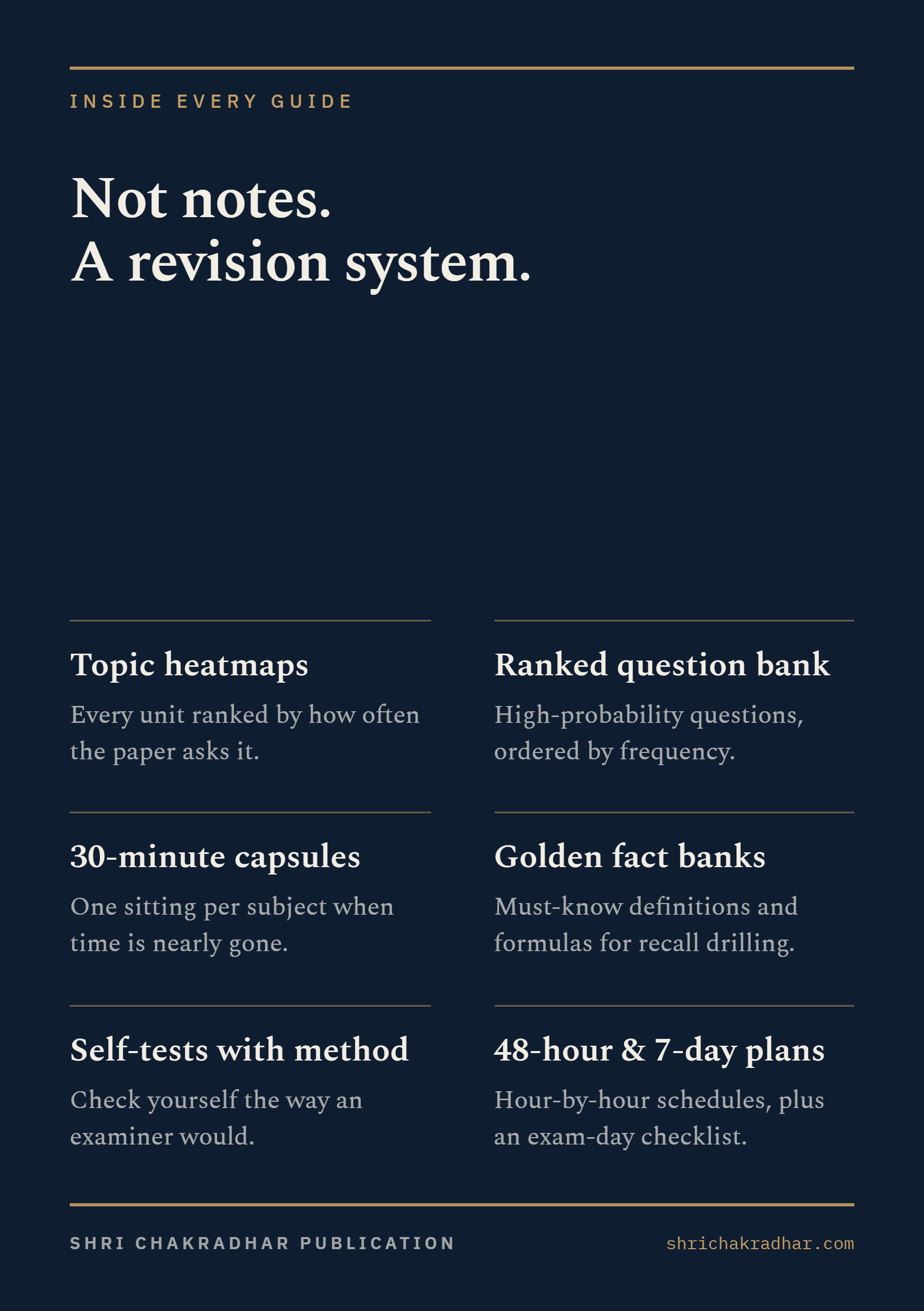
- Section A — Subject Opener and Topic Heatmap: identifies the paper pattern, four-block scope, recurring themes and the priority assigned to examinable areas.
- Section B — Command Verb Decoder and Golden Rule: explains what verbs such as define, test, calculate, compare, evaluate, discuss and advise require in the answer.
- Section C — Five Answer Blueprints: gives reusable structures, short skeletons and keyword sets for concepts, processes, computations, policy analysis and cases.
- Section D — Twenty-Five High-Probability Q&As: presents numbered model answers with one separate Exam Note after every response and four applied cases in each course.
- Section E — Revision Toolkit: consolidates thinkers, definitions, formulas or statutory terms, comparison tables and common examination mistakes.
- Section F — Thirty-Minute Revision Capsule: compresses the paper into five essential concept groups, selected questions, emergency opening lines and golden keywords.
Across four chapters, the book contains 20 Answer Blueprints, 100 model Q&As, 100 Exam Notes and 16 case-based practice exercises. It also supplies four topic heatmaps, four command decoders, four revision toolkits and four thirty-minute capsules. Semester-wide support adds a dashboard, a 48-hour emergency plan, study routes for 48, 24, 12, 6, 3 and 1 hour, 100 golden facts, an exam-day checklist, 40 multiple-choice self-tests, the answer key and score interpretation.
Subject-wise Coverage
MCO-03: Research Methodology and Statistical Analysis
MCO-03 takes the learner from a researchable question to a defensible report. Its coverage includes research objectives and type-pairs, the eleven-step research process, exploratory, descriptive and experimental designs, probability and non-probability sampling, primary and secondary sources, questionnaire construction, measurement scales, Likert and other attitude techniques, reliability, validity, editing, coding, classification and tabulation. Statistical work includes averages, dispersion, correlation, regression, probability, Z, t, chi-square, F and ANOVA, non-parametric tests, index numbers and time series. Kerlinger, Kothari, Fisher, Pearson, Likert and Cronbach provide the attribution base, while the cases address outlet research, paired training data, non-response and advertising-treatment design.
MCO-07: Financial Management
MCO-07 organises financial decisions around value. Students revise finance functions, profit versus wealth maximisation, time value, risk, CAPM, bond and equity valuation, cost of debt, preference and equity, WACC, payback, ARR, NPV, IRR and profitability index. The theory section covers Durand, Modigliani and Miller, capital-structure relevance and irrelevance, operating, financial and combined leverage, Walter, Gordon and dividend signalling. Working-capital coverage includes the operating cycle, cash budgets, Baumol and Miller-Orr, the five Cs of credit, receivables, EOQ, reorder level and selective inventory controls. Further answers address capital rationing, risk analysis, long-term finance, EBIT-EPS, ratio analysis and restructuring, with numerical cases ending in an explicit finance decision.
IBO-02: International Marketing Management
IBO-02 explains how marketing changes when one firm must operate across several legal, cultural and competitive environments. Perlmutter’s ethnocentric, polycentric, regiocentric and geocentric orientations lead into controllable and uncontrollable forces, self-reference criterion, psychic distance, segmentation, targeting and waterfall versus sprinkler expansion. Entry modes progress from indirect exporting through licensing, franchising, contract manufacturing and joint venture to a wholly owned subsidiary. Vernon’s international product life cycle supports product decisions, while standardisation, adaptation, packaging, labelling, branding, pricing, export price escalation, channels, promotion, services, logistics, payment methods, counter-trade, dumping and transfer pricing complete the mix. Four cases examine branded garments, landed-cost pressure, food-compliance rejection and partner-versus-subsidiary choice.
MCO-015: India’s Foreign Trade and Investment
MCO-015 links trade theory with India’s policy institutions and export structure. Smith, Ricardo, Heckscher-Ohlin, Leontief, Vernon, Krugman, Prebisch-Singer and Porter support answers on gains, competitiveness and terms of trade. The chapter distinguishes composition from direction and the balance of trade from the balance of payments, then studies deficit causes and correction. Legal and promotion coverage includes the FTDR Act, 1992, DGFT, Importer-Exporter Code, FEMA, 1999, Customs law, the SEZ Act, 2005, Advance Authorisation, EPCG, Duty Drawback, RoDTEP, SEZs, EOUs, EXIM Bank, ECGC and Export Promotion Councils. Sector and market analysis covers textiles, gems, agriculture, services, the EU, West Asia, the USA, ASEAN, Africa and China, with cases on residue rejection, district exports, exchange exposure and pharmaceutical-market selection.
MCO-03 to MCO-015 at a Glance
| Code | Subject Title | Main Revision Area | What You Take Away |
|---|---|---|---|
| MCO-03 | Research Methodology and Statistical Analysis | Research design, sampling, measurement, statistics, testing and reporting | A traceable path from question and data to interpreted evidence |
| MCO-07 | Financial Management | Valuation, cost of capital, investment, structure, payout and liquidity | Formula-led calculations followed by the financial decision they support |
| IBO-02 | International Marketing Management | Orientation, environment, entry, product, price, channel and promotion | International frameworks applied through Indian export situations |
| MCO-015 | India’s Foreign Trade and Investment | Trade pattern, external balance, export policy, institutions and sectors | Policy answers anchored in named laws, schemes, agencies and markets |
Key Features — All Verified From the Book
- 157-page English Medium edition: the four printed M.Com 3rd Semester course codes are combined inside one revision volume.
- 100 numbered model Q&As: every course contributes 25 selected questions and complete responses.
- 100 individual Exam Notes: each answer closes with a targeted reminder about method, notation, authority, provision or conclusion.
- 16 applied case exercises: four cases per subject test research design, financial judgment, export marketing and trade-policy application.
- 20 reusable Answer Blueprints: five course-specific structures appear in each chapter.
- 12 navigation and checking aids: four heatmaps, four command decoders and four revision toolkits support planning and correction.
- Four final-half-hour capsules: every course ends with must-remember concepts, selected prompts, emergency starters and keywords.
- Six reading depths: the time-based plans cover 48, 24, 12, 6, 3 and 1 hour.
- 100 golden facts: 25 entries per subject collect thinkers, years, formulas, statutory anchors and framework sequences.
- 40 self-test questions: ten MCQs per course are followed by an answer key and score bands.
Who Should Use This Book
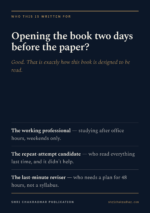
This combined study guide is intended for IGNOU M.Com 3rd Semester learners registered for MCO-03, MCO-07, IBO-02 and MCO-015. It is most useful after the prescribed blocks have been read and the student needs a practical route for final revision, answer construction and self-checking.
Working professionals and independent distance learners can use the six time plans when study hours are broken across employment, travel or family responsibilities. The book also supports candidates who understand a topic but omit the test conditions, finance decision, export illustration, statute year, scheme name or institutional role needed for a complete response.
How This Book Helps Students
The guide converts a broad semester into a chain of visible decisions. The heatmap identifies the starting point, the command decoder clarifies the examiner’s instruction and the blueprint sets the answer order before detailed content is recalled. MCO-03 separates method from inference, MCO-07 joins calculation with choice, IBO-02 connects each framework to market circumstances, and MCO-015 requires evidence, policy instruments and a measured verdict.
Model answers show those disciplines in full. Exam Notes flag omissions that frequently weaken otherwise informed responses. The cases test transfer from theory to facts, while definition banks, formula tables, comparisons, capsules, golden facts and MCQs create progressively shorter cycles of retrieval and correction.
This Exam Guide and IGNOU’s Official Study Material
This Last Minute Exam Guide supplements the university material; it does not replace it. IGNOU blocks provide the complete unit sequence, detailed explanations and source context required for foundational understanding. Students may download the official IGNOU M.Com study material free in PDF from eGyankosh and should use the files matching their registered course codes.
The book serves a later stage: selected-question practice, answer engineering, numerical rehearsal, policy recall and timed revision. Its probability markings indicate study priority based on earlier examination patterns and topic prominence. They do not identify the contents of a future Term-End Examination or remove any applicable area of the current syllabus.
Why Choose This Last Minute Exam Guide
The main distinction is that one navigation system preserves four different response disciplines. A research answer identifies design and limitations; a finance numerical states the formula, workings and decision; an international marketing response names the framework and the circumstances for using it; and a foreign-trade answer cites the statute, scheme or institution before evaluating effects.
The combined format also exposes useful links between the papers. Research supports evidence-based finance and market decisions, finance determines the resources available for international expansion, international marketing converts those resources into foreign demand, and trade policy defines the legal and institutional setting. The guide states its boundaries clearly and does not present selected questions as guaranteed examination content.
About the Author — BK Sahni
BK Sahni (Bhavya Kumar Sahni) is an IGNOU education expert, author, and the founder of Shri Chakradhar Publication Pvt. Ltd. and ignouproject.com, and he has guided 5,00,000+ IGNOU distance-learning students since 2010. He writes the Last Minute Exam Guide series — including this book — building every title on the method he has refined across a decade of IGNOU-focused work: high-probability questions, reusable answer blueprints, topic heatmaps and quick-revision capsules aligned to the current IGNOU exam pattern. He also publishes open-access research-methodology guides for IGNOU students, archived with permanent DOIs on Zenodo and indexed on Google Scholar and ORCID (0009-0005-8092-459X). Learn more about his work at bksahni.com, or browse his complete catalogue of IGNOU books on the Amazon Author Store.
How to Use the Book Effectively
Begin with the semester dashboard and identify whether the immediate weakness is research logic, financial computation, market application or trade-policy recall. Enter each chapter through Sections A and B, then learn the five blueprints before attempting Section D. Write selected answers without looking: state hypotheses and test choice in MCO-03, define every symbol and finish with a decision in MCO-07, add an Indian export illustration in IBO-02, and name the Act, authority, scheme or sector evidence in MCO-015.
Select the longest time plan compatible with preparation already completed. Extend whole-paper practice through IGNOU previous years solved question papers, and use free IGNOU study support and resources on IGNOU Project for supplementary guidance. Attempt all sixteen cases and forty MCQs, return to the relevant Section E after each error, and keep Section F for the final thirty-minute review before the paper.
Frequently Asked Questions
Which courses are covered in this IGNOU M.Com 3rd Semester Book?
The book covers MCO-03 Research Methodology and Statistical Analysis, MCO-07 Financial Management, IBO-02 International Marketing Management and MCO-015 India’s Foreign Trade and Investment. Each course has a separate six-section chapter containing a heatmap, command decoder, five Answer Blueprints, 25 model Q&As, four cases, a toolkit and a thirty-minute capsule.
Is this a single combined guide or four separate books?
It is one combined 157-page English Medium book. The four course codes remain clearly divided into independent chapters, but the same navigation sequence connects their priority maps, answer frameworks, model material and final summaries. The product is one 2027 M.Com Exam Edition rather than four separately bound helpbooks.
Can the guide support June and December Term-End Examination revision?
Yes. Its research procedures, financial formulas, international-marketing frameworks, trade statutes and recall resources can be used before either June or December Term-End Examination. The probability symbols help students order revision effort only; they do not confirm which questions will appear in a particular session.
Does the book include solved assignments, complete PYQs or a separate guess paper?
No. Solved assignments, full previous-year question papers, handwritten submissions and a standalone guess paper are not included. The book instead offers 100 model Q&As, sixteen applied cases, twenty Answer Blueprints, four revision toolkits, 100 golden facts and forty answer-keyed self-test questions for examination preparation.
Can this 157-page exam guide replace the prescribed IGNOU blocks?
No. A condensed revision volume cannot reproduce the complete unit development, readings and examples provided by the official study material. Use the prescribed blocks to build understanding, then use this guide for answer structure, statistical and financial practice, export examples, policy recall and final consolidation.
Who is the intended reader for the 3rd Semester edition?
The intended reader is an IGNOU M.Com learner registered for the four printed codes and already engaged with the syllabus. The combined format particularly suits working professionals, independent distance learners and students who need one organised method across research, numerical finance, international marketing and Indian foreign-trade papers.
How should students choose between the 48-hour and 1-hour routes?
Choose a plan according to preparation already completed as well as the time remaining. Longer routes permit wider Section D writing, all cases and self-testing; shorter options increasingly concentrate on high-priority answers, capsules and golden facts. The 1-hour route is only a rapid memory sweep, not a substitute for studying four courses.
Are the 100 selected questions predictions of the next examination?
No. They are revision priorities derived from recurring paper themes and topic prominence in the course material. Their purpose is to demonstrate complete answer forms and help allocate limited time. IGNOU may assess any relevant part of the current syllabus, including topics outside the selected set.
Should learners verify the current M.Com structure before ordering?
Yes. Students should check www.ignou.ac.in for the latest programme structure, course registration, study material, date sheet and examination instructions. This edition follows the MCO-03, MCO-07, IBO-02 and MCO-015 combination printed in the book, while the current official notification remains the final reference.
Important Note on Syllabus Verification
IGNOU periodically updates its programme structure, assignment requirements, examination schedule and study material. Before purchasing and while preparing, students should verify the latest M.Com syllabus, course list, date sheet and official instructions on the official IGNOU website (www.ignou.ac.in). This book is aligned to the MCO-03, MCO-07, IBO-02 and MCO-015 structure and refreshed as an annual exam edition, but official IGNOU sources are always the final authority.
Non-Affiliation Disclaimer
ignoustudymaterial.com is an independent educational publishing platform. This book and this website are not officially affiliated with, endorsed by, or operated by the Indira Gandhi National Open University (IGNOU). Course codes such as MCO-03, MCO-07, IBO-02 and MCO-015 are used solely to identify the subjects the book covers. IGNOU’s official study material and notifications remain the primary and authoritative sources for the programme.
Get Your Copy
Choose this combined M.Com revision guide when research methods, financial decisions, international marketing and Indian trade policy need to be organised inside one exam-focused source. Keep the prescribed blocks as the academic base, complete calculations independently and reserve the capsules for immediate recall. For digital access, get the IGNOU M.Com 3rd Semester Book (MCO-03 to MCO-015) — Combined Last Minute Exam Study Guide as a soft-copy PDF on WhatsApp.
| Weight | 250 g |
|---|---|
| Dimensions | 22 × 16 × 1 cm |


Reviews
There are no reviews yet.